

Portable Solar Panels: Wattage and Compatibility Guide

Portable solar panels turn sunlight into a practical charging input for power banks, power stations, phones, laptops, and other off-grid equipment. The best panel is not automatically the one with the highest watt rating. It is the panel whose output, voltage, connector, size, and construction match the equipment you will actually carry and use.
Explore KEUTEK portable solar panels in 40W, 60W, and 100W sizes for travel, camping, and emergency power planning.
Choose portable solar panels by starting with the input limits of your power bank or power station. Then compare panel wattage, operating voltage, current, connector type, portability, and outdoor protection. A 40W or 60W panel can suit smaller electronics and lighter travel, while a 100W panel can provide more useful input for a compatible power station. Rated output is a laboratory maximum, so placement, shade, heat, and panel angle affect real-world charging.
This guide focuses on the panel-first decision. You will learn how wattage relates to charging speed, how conversion efficiency affects size, how to check connectors and electrical limits, and how to choose a practical setup for camping, road trips, remote work, and outage preparedness.
What should you check before buying portable solar panels?
Before comparing panel designs, write down the equipment you want to charge and the specifications printed in its manual. The power station or power bank is the electrical boundary. A panel can physically connect and still be a poor or unsafe match if its voltage, current, polarity, or total wattage falls outside the receiving device's limits.
- Input voltage range: Confirm the receiving device's minimum and maximum solar input voltage.
- Maximum input current: Check how many amps the input can accept from one panel or a combined array.
- Maximum solar wattage: A station may limit how much of a higher-rated panel it can use.
- Connector and polarity: Confirm the plug type, adapter, pin arrangement, and positive-negative orientation.
- Use environment: Decide whether you need a packable panel, a kickstand, splash resistance, or a rigid mounting format.
Do not treat an adapter as proof of compatibility. An adapter solves a physical connection problem. It does not change an input voltage range or make an incompatible current profile safe. When specifications conflict, follow the power station or power bank manufacturer's documentation.
How does solar panel wattage affect charging?
Solar panel wattage describes the rate of electrical power a panel can produce under stated test conditions. It does not describe stored energy, and it does not guarantee that a connected power station will receive that amount. A 100W panel can provide more potential input than a 40W panel, but only when the receiving device accepts the extra power and the panel has strong, unobstructed sunlight.
Power stations are commonly described by storage capacity in watt-hours, or Wh. A panel is described by output in watts, or W. These numbers answer different questions:
- Watts: how quickly a panel can produce power or a device can draw it at a moment in time.
- Watt-hours: how much energy a battery can store and deliver over time.
- Charge recovery: how quickly the panel can replenish used battery capacity under actual conditions.
For a simple starting estimate, divide the energy you need to replace by the panel's expected field output. A 256Wh power station paired with a compatible 100W panel has a theoretical minimum near 2.6 hours before losses. That is not a promised charge time. Sun angle, shade, heat, cables, controller behavior, battery state, and the station's input ceiling all change the result.
Oversizing is not always wasteful, because a higher-rated panel may produce more useful input during less-than-perfect conditions. However, the panel still must remain inside the receiving device's voltage and current limits. If the station accepts 100W, buying a panel rated far above that limit will not necessarily shorten charging time.
What panel size fits camping, travel, and emergency use?
The most useful portable panel is one you can carry, open, aim, and store without turning every charging session into a project. Weight and folded dimensions matter as much as the nameplate rating. Car campers can usually carry more surface area than backpackers. A preparedness kit stored at home may favor output and durability over minimum weight.
| Panel range | Practical fit | What to verify |
|---|---|---|
| 40W class | It can suit phones, small power banks, lights, and lightweight travel kits when the receiving input accepts it. | Verify the power bank's solar input and expect slower recovery for larger batteries. |
| 60W class | It can balance portability with more useful input for small stations, cameras, tablets, and multi-device camp charging. | Confirm the DC voltage, current, connector, and the station's maximum solar wattage. |
| 100W class | It can be a practical choice for compatible power stations, remote work kits, and longer car-camping stays. | Confirm the station can accept the panel's voltage and current without clipping or exceeding its limits. |
| More than 100W | It can help replenish larger storage systems when the station is designed for the additional input. | Check every array and wiring limit before using series or parallel connections. |
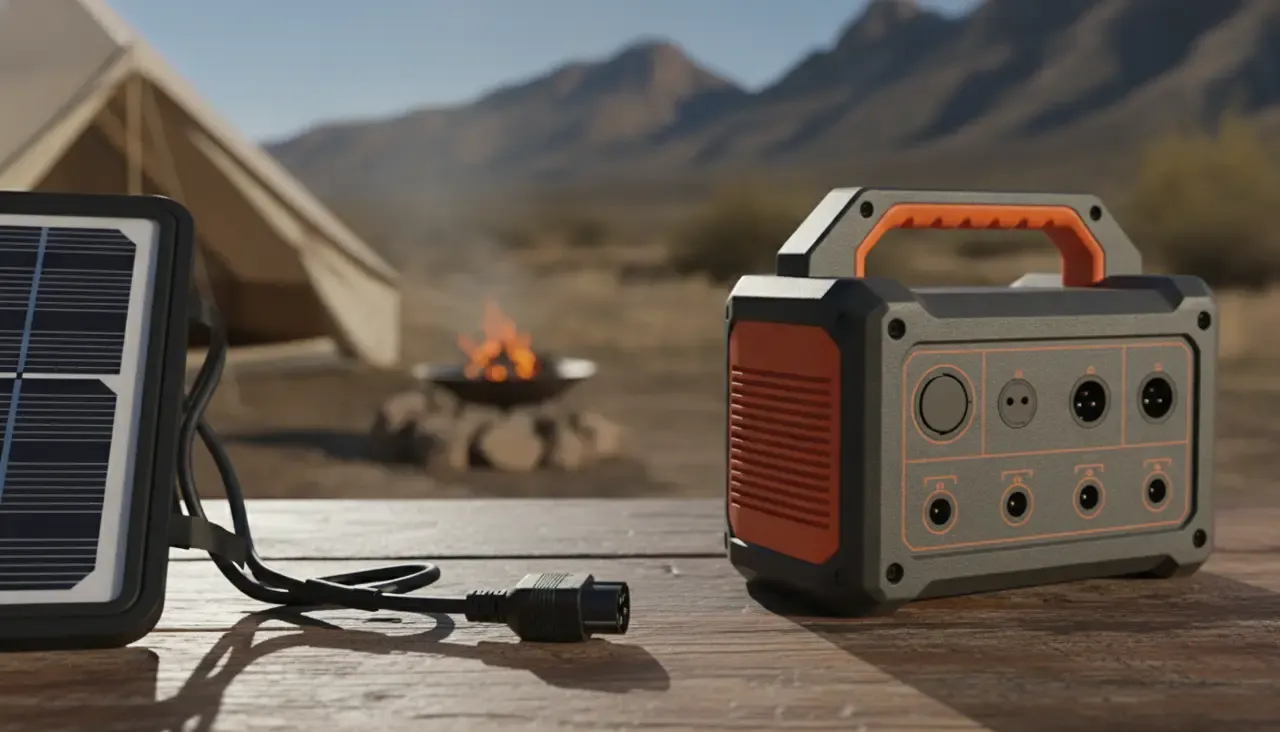
KEUTEK's solar panel collection includes 40W, 60W, and 100W foldable panels. The 40W model is listed at about 4.2 pounds, the 60W model at about 6.6 pounds, and the 100W model at about 9.7 pounds. These product-specific weights help illustrate the tradeoff: more rated output usually means more panel area and more gear to carry. Check the current product page for the specifications of the model you plan to use.
Does conversion efficiency determine which portable solar panel is best?
Conversion efficiency describes how effectively a panel converts available sunlight into electrical power. Higher efficiency can help a panel produce a given watt rating from a smaller surface area, but efficiency alone does not determine field performance. A shaded high-efficiency panel can produce less power than a lower-efficiency panel in clear, direct sunlight.
For a portable setup, evaluate efficiency alongside:
- Usable surface area: A compact folded panel still needs enough open area when deployed.
- Sun angle: Directly facing the sun generally produces more useful input than a flat or partially turned panel.
- Heat and ventilation: Excess heat can affect output, so avoid covering the panel or trapping it against hot surfaces.
- Shade: A branch, tent edge, or vehicle shadow can reduce production significantly.
- Deployment time: A panel with a kickstand or carrying case may be easier to position consistently.
KEUTEK's 40W, 60W, and 100W solar panel product pages describe monocrystalline cells and up to 22% conversion efficiency. Use that figure as a product specification, not as a guarantee of delivered wattage in every location. The U.S. Department of Energy's solar overview explains that photovoltaic systems depend on light availability and system conditions, which is why real-world output varies.
See the KEUTEK 100W portable solar panel when you need more panel capacity for a compatible power station or travel-ready backup kit.
Related products


Which connectors and electrical ratings must match?
Compatibility has two layers: the plug must fit, and the electrical characteristics must be acceptable. Common portable solar setups may use USB-A, USB-C, DC barrel connectors, MC4 connectors, XT-style plugs, or proprietary adapters. There is no single connector shape that makes every panel and power station interchangeable.
Which panel specifications matter most?
- Open-circuit voltage, or Voc: the panel voltage when it is not supplying a load. It must stay below the receiving device's maximum input voltage, including the manufacturer's cold-weather guidance.
- Voltage at maximum power, or Vmp: the operating voltage associated with the panel's rated output. It should sit within the receiving device's usable operating range.
- Current at maximum power, or Imp: the approximate operating current at the panel's maximum power point.
- Short-circuit current, or Isc: a panel specification used when checking current limits and wiring configurations.
- Polarity: the positive and negative conductors must be arranged correctly for the input.
Series connections raise voltage. Parallel connections raise current. Both can be useful in a designed system, but both can also push an input beyond its limit. Never connect panels in series or parallel based only on matching wattage. Compare the resulting voltage and current with the exact power station manual.
KEUTEK's 100W panel lists USB-A, USB-C, and DC 18V output options and includes 10 DC adapters. That broadens the number of devices it may connect to, but you should still confirm the receiving equipment's specifications. The 40W and 60W models also list multiple DC and USB output options. Connector variety improves flexibility, not universal compatibility.
How weather-resistant should portable solar panels be?
Outdoor use exposes panels to splash, dust, handling, and changing temperatures. Look for a stated ingress or water-resistance rating, reinforced seams and connectors, a stable kickstand, and a storage case or pouch. A water-resistant panel is not automatically waterproof in every position, and no rating eliminates the need to protect the power station and connectors from standing water.
KEUTEK's portable panel pages list IPX4 water resistance, foldable construction, a kickstand, and a polyester pouch. IPX4 is useful information for splash exposure, but it should not be read as permission to leave the panel submerged, uncovered in severe weather, or connected while water is collecting around the equipment. Dry the panel and connectors before storage, and keep the receiving battery or power station protected according to its own manual.
Durability also includes the parts you handle most. Inspect hinges, cable exits, adapters, and connector housings before each trip. A clean, dry connector makes a more reliable connection than one exposed to grit or moisture. Store folded panels without sharp bends, heavy objects on top, or loose adapters rubbing against the cells.
How can you get more useful output in the field?
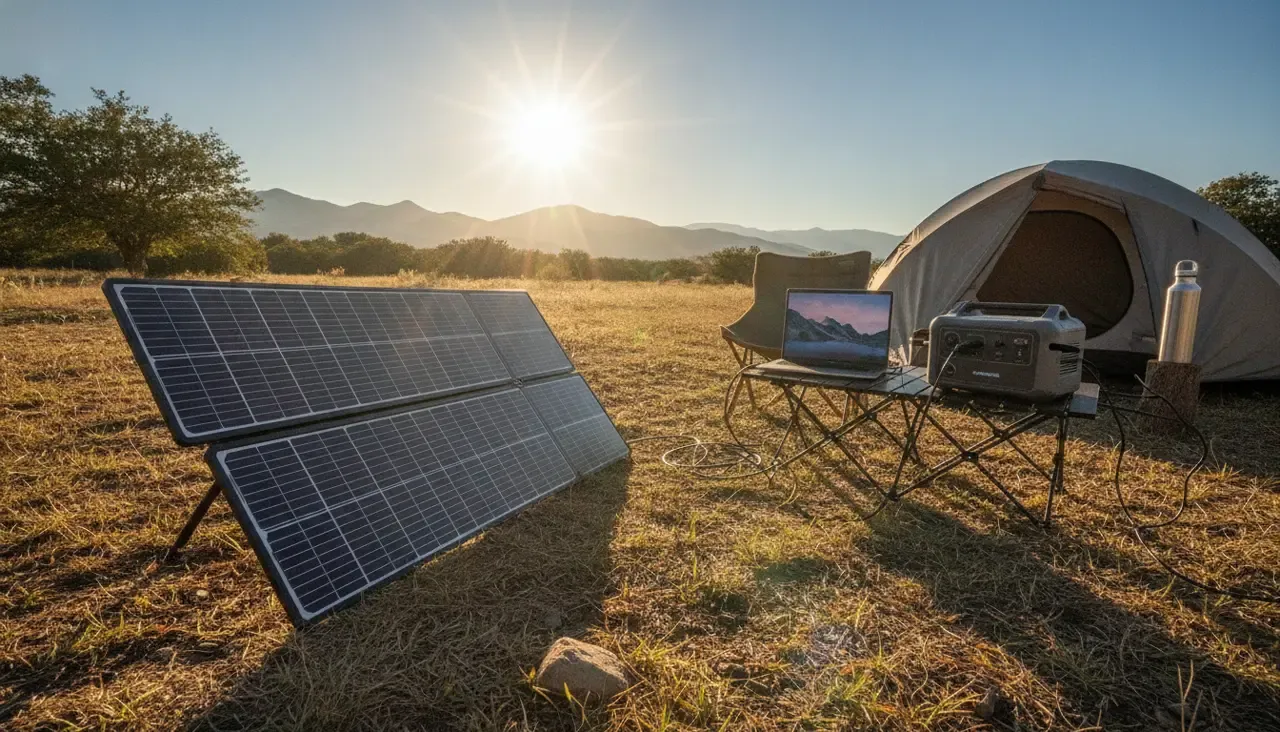
Good placement often matters more than a small difference in advertised wattage. Set the panel where it has an unobstructed view of the sun, use its kickstand when available, and re-aim it as the sun moves. Keep cables as short as practical without creating strain, and monitor the power station display so you can see whether the input is behaving as expected.
- Start with a charged battery: Use wall or vehicle charging before departure when available, then use solar to extend the reserve.
- Deploy in clear sun: Avoid tree shadows, tent edges, vehicle shade, and dusty surfaces.
- Check the screen: Confirm the station is accepting solar input and note how conditions change the reading.
- Protect the connection: Keep adapters off wet ground and avoid pulling the cable tight.
- Plan for less than the rating: Build extra time into a trip or outage plan rather than depending on a perfect-sun estimate.
A compatible KEUTEK 300W Portable Power Station Max has a 256Wh capacity, 300W continuous output, a 600W peak rating, and solar charging support for a 100W panel according to its product information. Those specifications describe that specific station, not every portable power station. Always pair the panel with the exact model's published input limits.
Which portable solar panels are right for you?
Choose the smallest panel that meets your recovery needs when portability is the priority. Choose a larger panel when you have room to carry it, the receiving station accepts its input, and faster recovery is valuable. For a compact emergency kit, a 40W panel can be easier to store. For car camping or a small power station, a 60W or 100W panel may offer a more useful balance. For any choice, compatibility comes before headline wattage.
| Your priority | Starting direction | Do not skip |
|---|---|---|
| Minimum weight for day trips | Consider a lower-watt foldable panel that matches your power bank. | Confirm the panel can deliver the voltage the power bank needs to charge. |
| More reliable camp recovery | Consider a 60W or 100W panel when the station accepts the additional input. | Compare Voc, Vmp, current, connectors, and the station's maximum solar wattage. |
| Emergency preparedness | Prioritize storage, repeatable deployment, and enough panel output for the backup battery. | Allow for clouds, shade, heat, and several hours without useful sunlight. |
| Remote work or multiple devices | Match panel recovery to the station's Wh capacity and your daily device load. | Check both battery capacity and simultaneous output, not panel wattage alone. |
Portable solar works best as a complete plan: panel, battery or power station, cables, adapters, placement, and realistic weather assumptions. KEUTEK's portable power station and solar panel guide covers the station side of the decision, while its portable solar power kit guide explains what a complete kit may include. That approach helps outdoor adventurers and prepared families avoid buying a panel that looks powerful on paper but cannot safely or conveniently charge the equipment they own.
Compare KEUTEK portable solar panels and choose the wattage, foldable format, and connection options that fit your actual setup.
Portable solar panels FAQ
What are portable solar panels used for?
Portable solar panels collect sunlight to charge compatible power banks, power stations, phones, tablets, and other electronics away from a wall outlet. Their usefulness depends on panel output, sunlight, the receiving device's input limits, connectors, and how much energy the connected battery needs.
Are 100W portable solar panels better than 40W panels?
Not in every situation. A 100W panel can provide more potential input when the receiving device accepts it, but it is larger and heavier. A 40W panel can be more practical for light travel or small power banks. Choose the wattage that matches your input limits, energy needs, carrying space, and expected sunlight.
Can any portable solar panel charge any power station?
No. Check the panel's Voc, Vmp, Imp, connector, polarity, and total wattage against the power station's solar input range and maximum limits. A connector adapter may solve a physical fit issue, but it does not make incompatible voltage or current safe.
Do portable solar panels work on cloudy days?
They can produce some power in bright overcast conditions, but output is lower and less predictable than in direct sunlight. Shade, cloud cover, panel angle, heat, dust, and cable losses all affect production. Plan extra charging time and keep the battery charged before a trip or expected outage.
Are foldable solar panels weatherproof?
Do not assume that every foldable panel is weatherproof. Check the exact product's water-resistance rating and protect the battery, connectors, and cables from standing water. KEUTEK's listed portable panels specify IPX4 water resistance, which supports splash protection but is not the same as submersion protection.


Leave a comment