

Portable Power Supplies: Travel and Emergency Guide

The right backup battery depends less on having the biggest number on the box. It depends on where you will carry it, what you need to charge, and how you can recharge it. A professional moving between airports may need pocketable power for a phone and tablet. A campsite group or outage kit may need more capacity, ports, and AC-style output.
Portable Power Supplies range from compact power banks for personal electronics to solar power banks for off-grid top-ups and portable power stations for higher-output, higher-capacity backup. The best choice balances portability, device demand, recharge options, and the conditions where you will use it.
Those tradeoffs become clearer when the three formats are compared side by side. Start with the basic differences in battery capacity, output, recharge methods, and physical size, then match each format to business travel, road trips, camping, or essential home backup.
Explore KEUTEK portable power options for your next trip or emergency kit.
What Are Portable Power Supplies, and How Do the Main Formats Differ?
Portable Power Supplies are rechargeable devices that store energy so you can charge or operate electronics away from a fixed outlet. The category includes pocket-sized power banks, solar power banks, and larger portable power stations. The right choice depends less on a single headline specification than on the balance of output, capacity, recharge options, portability, and intended use. KEUTEK portable power and charging solutions are designed around that same practical balance.
Think of the three formats as different points on a portability-to-capacity spectrum. A compact power bank is built for personal electronics. A solar power bank adds a way to replenish energy outdoors. A portable power station prioritizes higher output and capacity for campsite, travel, and bounded backup needs.
Portable power stations are commonly described as battery-powered generators for keeping gear running away from a fixed outlet. They are not interchangeable with every type of generator or home backup system. Output and capacity should always be matched to the intended use.
Compact power banks: the everyday carry option
Choose a compact power bank when the priority is keeping a phone, earbuds, smartwatch, or similar personal device charged during a commute, meeting-heavy day, or flight. Its strengths are low weight, simple operation, and easy storage in a bag or pocket. Capacity and output are sized around individual devices, so it is practical for one person rather than a group at a campsite. Recharge is typically handled through a wall charger or another compatible power source, which makes this format most useful when you can restore it between trips.
Solar power banks: portable charging with an outdoor recharge option
A solar power bank serves a similar small-device role, but adds solar input for situations where access to an outlet is limited. That makes it appealing for hiking, camping, travel, and emergency communication. The tradeoff is that solar availability affects how useful the recharge feature is. Treat it as an outdoor top-off option, not an automatic replacement for a wall outlet. Its compact form remains easier to carry than a power station, while its capacity and output are generally intended for personal electronics.
Portable power stations: more output for a basecamp or kit
A portable power station is the capacity-focused choice. It can support more devices, deliver higher output, and provide quiet backup power for camping, travel, or an outage when the connected load is within its specifications.
The added battery capacity and output come with more size and weight. That makes a station better suited to a vehicle, campsite, or home emergency kit than an everyday pocket. Compare the available ports, recharge methods, and physical portability before buying. Select a power bank for personal mobility, a solar power bank for small-device charging with outdoor flexibility. And a power station when shared charging and greater capacity matter more than minimal weight.
Which Portable Power Supplies Fit Business Travel and Air Travel?
For a business trip, the most practical choice is usually a compact power bank sized for personal electronics. It can ride in a work bag, keep a phone available between meetings, and provide extra charging for a tablet without the bulk of a larger station. Before choosing one, list the devices you will carry, their charging connectors, and how often you expect to be away from an outlet. A power bank that matches your actual phone and tablet needs is easier to pack and simpler to use than a solution designed for loads you will not bring.

What Wh rating is allowed on a passenger aircraft?
Airlines and airport security evaluate rechargeable batteries by watt-hours, or Wh. The Federal Aviation Administration says rechargeable batteries from 0 to 100 Wh are allowed on passenger aircraft. Batteries from 101 to 160 Wh require approval from the airline, while batteries exceeding 160 Wh are forbidden on passenger aircraft. Check the battery label and the current rules for your airline before departure, especially if you are considering a higher-capacity unit.
Spare lithium batteries, including power banks and portable chargers, must be carried on and cannot be placed in checked baggage. Keep the power bank accessible in your cabin bag. And do not assume that a portable power station is suitable for a flight simply because it is easy to carry. Capacity, battery type, physical condition, and airline policy all matter. For a practical review of the relevant guidance, see KEUTEK's power banks for air travel guide.
How can you prepare a power bank safely?
Lithium-ion batteries can overheat and experience thermal runaway. The FAA identifies damage, overheating, water exposure, overcharging, improper protection, and manufacturing defects as possible factors. Inspect a power bank before packing it. Do not fly with a battery that is damaged, recalled, swollen, or showing signs of dangerous heat. The FAA says damaged or recalled batteries that could spark or generate dangerous heat must not be carried aboard an aircraft unless they have been removed or otherwise made safe.
During the flight, stop using a device or power bank if it becomes unusually hot, expands, smokes, or burns, and notify the flight crew immediately. For most professionals, a compact power bank within the standard 0 to 100 Wh range offers the cleanest balance of portability and capacity. If your tablet, laptop, or travel schedule demands more, verify the device requirements and obtain airline approval before packing a larger battery.
How Should You Choose Capacity, Output, and Ports?
Start with the devices you actually need to power, not the largest number on a product page. Capacity is measured in watt-hours (Wh), a unit that helps estimate how long connected loads can run. Output is measured in watts (W), which tells you how much power the supply can deliver at one time. A unit with plenty of Wh can still be a poor fit if its output is below your laptop, camera charger, or other device's requirement.
How do Wh and watts affect runtime?
Use your device's rated wattage as a planning reference. In a simplified estimate, divide available watt-hours by the device's wattage. A 280Wh supply connected to a 40W load could provide up to about seven hours in ideal conditions. Before accounting for conversion losses, battery reserve, and changing device demand. Treat that result as an estimate, not a guarantee. Chargers and electronics do not always draw their maximum or constant wattage.
Capacity also influences portability. More Wh usually means a larger battery, more weight, and more space in a travel bag or vehicle. A compact power bank may be the smarter choice for a phone and earbuds. While a larger station is more appropriate when several people need to charge devices at a campsite or during a short outage. KEUTEK's category guidance is to balance pocketability, capacity, output, recharge time, and intended use rather than maximize one specification.
Which ports and output types do you need?
Count the devices that may be connected at the same time, then inspect both the port types and their limits. USB-C can suit newer phones, tablets, and compatible laptops, while USB-A remains useful for older cables and accessories. Check the per-port rating and the unit's total output when multiple ports operate together.
Also decide whether you need DC output only or AC output through an inverter. DC output is often efficient for phones, tablets, lights, and other electronics designed for direct charging. AC outlets can support compatible plug-in chargers, but the inverter adds conversion overhead. Never assume an AC outlet can run a device simply because the plug fits. Compare the device's running wattage and any startup demand with the supply's continuous and peak ratings. KEUTEK describes its 300W portable power station with a 280Wh capacity, pure sine wave inverter, and 600W peak surge specification. Confirm current product-page details before relying on those figures for a specific device.
How should you plan recharging?
Choose recharge options that match your routine. Wall charging is practical when an outlet is available, car charging helps on road trips, and solar input can extend time away from the grid. Solar timing depends on capacity, panel wattage, and weather. A basic estimate divides Wh by available solar watts, but direct sunlight is variable, so allow additional time.
- List each device, its wattage, and the number of simultaneous users.
- Choose enough Wh for the intended runtime, with a realistic reserve.
- Match continuous and peak output to device demands.
- Confirm USB, DC, or AC ports and total shared output.
- Compare wall, car, and solar recharge options with your travel conditions.
- Check airline rules and weather requirements before travel or outdoor use.
Related products

Replacement for a worn, damaged, or missing compatible port cover
View product

When Is a Solar Power Bank the Better Choice for Camping?
A solar power bank is a strong fit when your camping setup revolves around small personal devices and you want a recharge option beyond a wall outlet. It can help keep a phone available for navigation and emergency communication, support a smartwatch or small light, and add practical flexibility during a remote trip. That makes it different from a traditional power bank, which is typically recharged before departure. And from a portable power station, which is designed for higher output and larger group loads.
The tradeoff is simple: solar adds independence, but it does not create unlimited power on demand. Solar recharge depends on the battery capacity, available solar input, and weather conditions. Even direct sunlight can produce variable results, so treat the panel as a top-off method rather than a guaranteed replacement for a full recharge. Place the unit where it receives unobstructed light, and plan to recharge devices from the battery when the sun is strongest. Cloud cover, shade, short winter days, and a campsite under dense trees can all reduce useful input.
What should you expect from solar charging outdoors?
Think in terms of extending your available charge, not quickly filling an empty battery between every activity. A phone, watch, headlamp, or other small device is a more realistic match than a laptop, cooler, heater, or cooking appliance. If several people need power for multiple days, compare the total battery capacity and output ports before choosing a solar power bank. Outdoor shoppers also need to weigh weather resistance, physical size, and carrying weight against the convenience of having solar available.
Weather protection still matters. Check the product's published protection details, keep charging ports covered when they are not in use, and shelter the power bank from rain and severe weather. A weather-oriented design is not permission to leave electronics exposed indefinitely. Avoid charging or storing the unit where water can enter, and inspect it after rough travel or a fall.
For a compact camping kit, a rugged solar power bank makes sense when portability and small-device access matter more than AC-style output. KEUTEK states that this model uses gel electrolyte technology intended to last nine times longer than conventional lithium-ion batteries. A product-specific claim you should review on the product page. This section focuses on the decision between power formats. For a deeper look at solar power bank features, compare that guide separately rather than assuming every solar product delivers the same recharge experience.
When Does a Portable Power Station Make Sense for Road Trips and Camping?
A portable power station earns its space when a trip involves more than one or two personal devices. It can serve as a shared charging hub at a campsite, a practical basecamp supply for a road trip. Or a quiet backup option for essential small electronics when an outlet is unavailable. The tradeoff is straightforward: more capacity and output usually mean more size and weight than a pocket power bank.
Start with the loads you actually expect to connect. Capacity is measured in watt-hours (Wh), while output is measured in watts (W). Wh describes the battery's stored energy; W describes the power a connected device requires at a given moment. A station must meet both requirements. Check the device label or manufacturer specifications rather than assuming an appliance will work. And treat any runtime estimate as dependent on the device, conversion losses, and operating conditions.
What should you check before choosing a station?
- Capacity: Choose enough Wh for the number of phones, tablets, cameras, lights, or other planned loads, without carrying substantially more battery than the trip requires.
- AC and DC output: AC outlets can support compatible plug-in equipment within the station's rated wattage. DC outputs and USB ports are often a more efficient match for phones and other electronics because they avoid unnecessary power conversion.
- Ports: Count how many people will charge at once. A mix of USB, DC, and AC connections can reduce adapters and keep a group organized.
- Recharge: Compare wall, vehicle, and solar input options. Solar recharge depends on station capacity, panel wattage, and weather, so it is best treated as a useful option rather than a guaranteed schedule.
- Battery chemistry and noise: LiFePO4 models are valued for long service life, while fan noise and thermal management matter when the station is near a tent, work area, or sleeping space.
- Weather limits: An IP rating, when provided, indicates tested water and dust resistance, but it does not make a station safe to leave exposed. Keep it protected from rain, standing water, and severe weather.
| Trip situation | Why a portable power station may fit | What to verify first |
|---|---|---|
| Road trip basecamp | A station can centralize charging for phones, cameras, lights, and other compatible electronics away from an outlet. | Verify vehicle recharge support, available ports, packed weight, and the wattage of every planned load. |
| Group camping | A higher-capacity battery can support shared charging and campsite electronics without requiring each person to carry a separate bank. | Confirm capacity, simultaneous-output limits, fan noise, and a dry, shaded placement plan. |
| Larger essential loads | AC-style output can accommodate compatible equipment when its starting and running wattage stay within the station's ratings. | Check the device specification and surge requirement; do not infer runtime or compatibility from capacity alone. |
For a compact station option, review the 300W portable power station and confirm its current product-page specifications before purchase. For travelers whose needs are primarily in-car USB charging, a multi-port car charger for road trips may be the lighter, simpler choice.
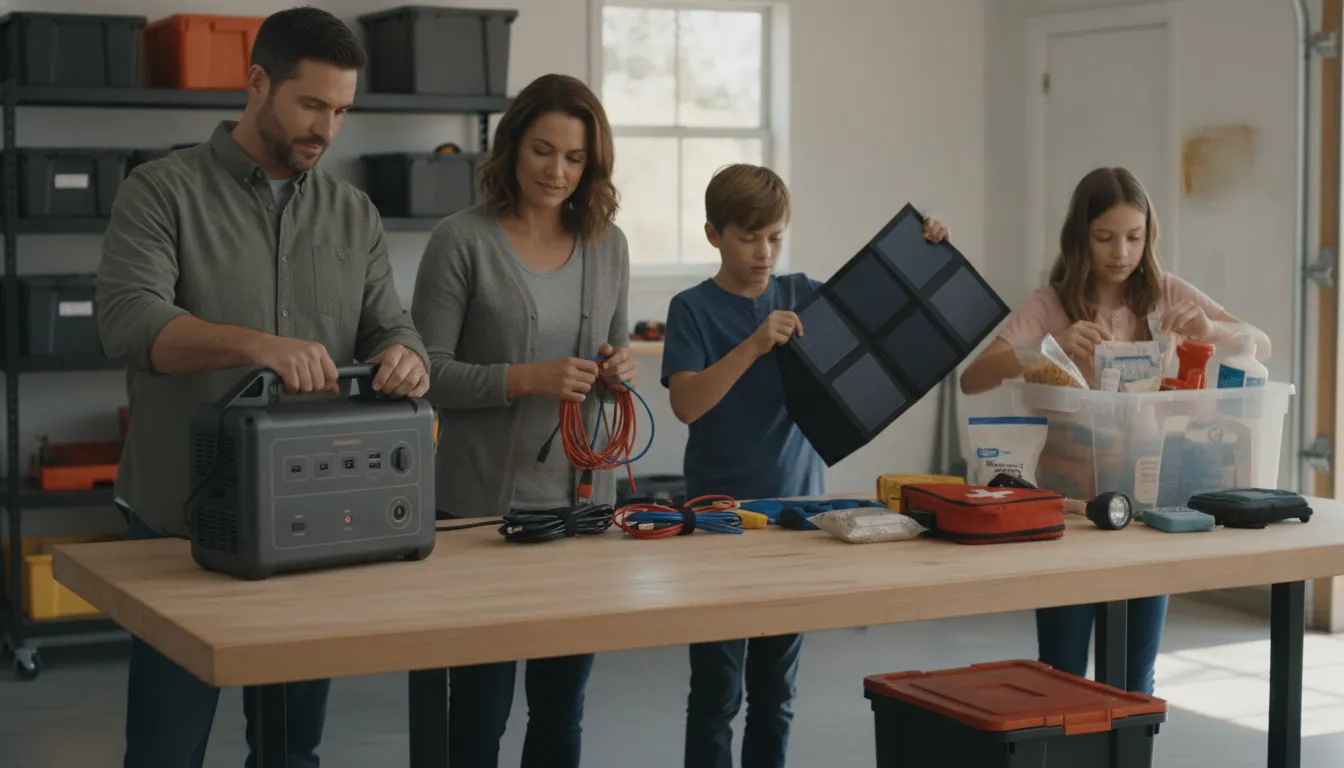
How Can You Build a Bounded Home Emergency Power Kit?
A practical outage kit should protect communication, information, and basic device access, not pretend a compact battery can replace a professionally installed whole-home backup system. Start with the small electronics your household depends on most: phones, tablets, rechargeable lights, radios, medical-device accessories where the manufacturer's requirements permit, and a laptop for essential work. A portable power station can offer more capacity and more output options than a power bank. While a power bank is easier to keep beside a go-bag or move between rooms. Choose based on the loads you actually need to support.
- Define the essential loads. List each device, its charging connector, and its wattage or battery capacity. Prioritize emergency communication and lighting before convenience electronics. Do not assume that an available AC outlet means a station can safely or continuously run an appliance. Confirm the station's continuous output, surge rating, and port requirements against the device documentation.
- Match the format to the job. For one or two phones and small USB devices, a charged power bank may be sufficient. For several people, multiple charging ports, or a longer outage, a portable power station may be more practical. Keep the boundary clear: unless the product documentation verifies a larger load, plan for essential small electronics rather than refrigerators, heaters, pumps, or other high-demand appliances.
- Build a complete charging kit. Store compatible cables, wall adapters, and a vehicle charging option with the battery instead of relying on a cable drawer during an outage. Label cables by device if several connectors look alike. Test every connection before storing the kit, then recharge the battery according to the manufacturer's instructions and check its status periodically.
- Store it dry, cool, and accessible. Keep the power supply indoors in a dry location away from direct heat, standing water, and severe weather. Some stations have tested water and dust resistance, but a weather rating is not permission to leave a battery exposed. Protect ports from moisture and impact, and never use a damaged, swollen, or unusually hot battery.
- Separate battery backup from fuel-generator safety. A battery station does not produce engine exhaust, but a fuel generator does. The Consumer Product Safety Commission warns that generator carbon monoxide can kill in minutes and says never to use a portable generator indoors. In a garage, basement, or shed. Operate one outdoors, well away from windows, doors, vents, and other openings, and keep a working carbon monoxide alarm in the home. Carbon monoxide is a poisonous gas you cannot see or smell. Review the CPSC generator safety guidance before use.
Revisit the kit when your devices, household needs, or outage plans change. The strongest setup is the one you can identify quickly, operate safely, and verify before an emergency occurs.
Frequently Asked Questions
What is the best portable power supply?
The best option depends on what you need to power and where you will use it. Choose a compact power bank for phones, tablets, and light business travel. Choose a solar power bank when outdoor portability and solar top-off capability matter. Choose a portable power station when you need greater capacity, more ports, or AC-style output for a campsite, road-trip basecamp, or essential small electronics during an outage.
Are Portable Power Supplies allowed on airplanes?
Check the battery rating in watt-hours and your airline's current policy before flying. The FAA allows rechargeable batteries from 0 to 100 Wh on passenger aircraft, while batteries from 101 to 160 Wh require airline approval. Batteries over 160 Wh are forbidden. Spare lithium batteries and power banks must travel in carry-on baggage, not checked luggage. Review the FAA's passenger battery guidance before departure.
Is a portable power station worth buying for camping?
It can be worthwhile if you regularly camp with several people or need to recharge multiple devices away from outlets. A station offers more capacity and output than a personal power bank, but it also adds weight and takes more space. For a solo trip focused on phone or smartwatch charging, a compact power bank may be the more practical choice.
Can a portable power station replace a home generator?
A battery station can provide quiet backup for essential small electronics, such as phones, lights. And communication devices, but it is not automatically a substitute for a whole-home backup system. Do not confuse it with a fuel-powered generator. The CPSC warns that portable generators must never be used indoors, in garages, basements, or sheds because carbon monoxide can be deadly. See the CPSC generator safety guidance.
Ready to Explore the Right Portable Power Supply?
The right format depends on how you plan to use it, from keeping devices charged while traveling to supporting essential electronics at camp or home. Compare capacity, portability, charging options, and output in one place to narrow your choices. Explore KEUTEK's fast-charging portable power collection to compare options for travel, camping, and emergency kits.


Leave a comment