

Portable Power Station: How to Choose the Right One

A laptop, phone, camera, light, or small appliance can quickly turn a convenient backup battery into an undersized one. The best choice starts with the devices you need to power, how long you need them running, and how easily you can carry the station.
Explore KEUTEK's 300W Portable Power Station Max for a compact, travel-ready power solution.
A Portable Power Station is a rechargeable battery hub that supplies AC, DC, and USB power. Choose one by matching watt-hours to runtime and watts to simultaneous device demand. Then compare battery chemistry, ports, recharge speed, solar input, size, and safety features with your travel, camping, or backup needs.
How Do You Size a Portable Power Station by Watt-Hours and Wattage?
Watt-hours (Wh) describe stored energy, while watts (W) describe the power a station can deliver at one time. Both numbers matter. A station may have enough energy for a long outing but still fail to start a device that exceeds its continuous or surge rating. For a basic comparison between a power bank and a Portable Power Station, see KEUTEK's power bank comparison guide.
- List the devices. Record each device's operating wattage and expected hours of use. Include only devices that may run simultaneously when checking output.
- Add simultaneous loads. A 60W laptop, 20W monitor, and 10W light require at least 90W of continuous output. Leave headroom rather than operating at the limit.
- Estimate energy. Use required Wh = device watts x operating hours. A 60W laptop used for four hours has an estimated demand of 240Wh before conversion losses.
- Check startup demand. Motors, compressors, pumps, and some tools draw more power briefly at startup. Compare that surge with the station's peak rating.
- Confirm published limits. Check the station's continuous output, peak output, usable capacity, outlet limits, and manufacturer guidance before connecting equipment.
Runtime estimates are planning tools, not guarantees. AC conversion losses, device behavior, temperature, and battery condition affect usable energy. The safest buying decision matches both Wh and W to your actual load, with enough capacity for the duration and enough output for the devices operating together.
Why do watt-hours and watts answer different questions?
Wh answers how long a battery may support a load. W answers whether the station can support that load at all. For example, a 240Wh station may have enough stored energy for a 60W laptop used for several hours. But its inverter still needs a continuous rating above the laptop's demand. Checking only one number can lead to a poor fit.
How much reserve should you plan?
Leave practical headroom for conversion losses, changing device demand, and unexpected use. The exact reserve depends on the station and load, so use the manufacturer's usable-capacity guidance instead of treating the printed battery capacity as fully available AC energy. A conservative estimate is especially important during an outage, when recharging may not be convenient.
What Will a Portable Power Station Run?
A Portable Power Station can recharge phones, cameras, tablets, laptops, lights, and other modest electronics. Some models can also run small appliances, fans, televisions, pumps, or medical equipment when the device's operating and startup demands stay within the station's specifications. Always check the specific device and station manuals before use.
Start with continuous wattage
Continuous wattage is the output a station can sustain during normal operation. Add the running wattage of every device you expect to use at the same time, then compare that total with the station's continuous rating. A station rated at 300W is not a universal 300W appliance replacement. It is a better fit when the combined load remains comfortably below 300W.
Check startup surge before connecting motor-driven devices
Startup surge can exceed the running wattage of a refrigerator, pump, fan, compressor, or power tool. A station may appear compatible based on the device's normal rating and still shut down when the motor starts. Check the device's startup requirement and the station's peak rating. If either number is unavailable, do not assume reliable operation.
Account for inverter conversion
The battery stores DC energy. An AC outlet uses an inverter to convert that energy to household-style AC, and the conversion consumes some power. That is why dividing advertised Wh by appliance watts does not produce an exact runtime. DC and USB outputs can be more efficient for compatible devices because they avoid an unnecessary AC conversion.
Choose an appropriate AC waveform
A pure sine wave inverter is generally the safer choice for laptops, monitors, audio equipment, and other sensitive electronics. Check the station's output waveform, outlet rating, and safety instructions. For heating elements and high-draw tools, verify compatibility rather than relying on the presence of an AC outlet alone.

Related products


LiFePO4 vs NMC: Which Battery Chemistry Fits Your Use?
Battery chemistry affects a Portable Power Station's balance of longevity, safety, weight, and energy density. LiFePO4 means lithium iron phosphate. NMC means nickel manganese cobalt. Neither chemistry wins for every situation, so prioritize the traits that match how often you cycle the station, how far you carry it, and where you store it.
| Consideration | LiFePO4 | NMC |
|---|---|---|
| Repeated use | LiFePO4 is generally associated with long cycle life for frequent camping, backup, and jobsite use. | NMC can fit occasional use where compact size and lower weight are higher priorities. |
| Thermal behavior | LiFePO4 is known for a strong safety and thermal stability profile when properly designed. | NMC depends on sound battery management, charging controls, and sensible operating conditions. |
| Size and weight | LiFePO4 may require more mass for comparable stored energy. | NMC can offer higher energy density for a lighter or smaller design. |
| Best fit | LiFePO4 suits buyers who value durability and repeated cycling. | NMC suits buyers who prioritize portability for shorter or less frequent trips. |
How should you store either battery chemistry?
Store either type in a cool, dry place away from excessive heat and moisture. Follow the manufacturer's storage instructions and recharge on the recommended schedule. KEUTEK advises bringing its 256Wh LiFePO4 unit to approximately 80% every three to six months during long-term storage. Do not leave a battery station in a hot vehicle for extended periods.
Actual battery life depends on depth of discharge, temperature, charging practices, and the station's battery-management system. Treat chemistry comparisons as selection guidance, not a promise of a specific lifespan.
What makes LiFePO4 useful for repeated travel?
LiFePO4 is a practical choice when the station will be charged and discharged often. It supports the durability-focused use cases common to camping, road trips, and emergency readiness. That does not remove the need for proper storage or safe charging. Review the product's full specifications and care instructions before making a purchase.
Which Ports, AC Outlets, and Fast-Charging Features Matter?
The right port mix determines whether a Portable Power Station works with your routine or becomes an expensive battery you cannot easily connect. Start with your device list, then compare AC outlets, DC or car-style outputs, USB-A, USB-C Power Delivery, total output limits, and the station's charging methods.
Which outputs should a station include?
AC outlets support standard chargers, laptops, monitors, and compatible small appliances. DC or car-style outputs can be efficient for compatible travel and camping equipment. USB-A supports common charging cables, while USB-C is useful for newer phones, tablets, cameras, handheld consoles, and supported laptops. Confirm voltage, connector, polarity, and power rating before use.
When does USB-C PD make a difference?
USB-C Power Delivery negotiates an appropriate charging level with a compatible device. It can provide faster charging than a standard USB port when the station, device, and cable all support the required profile. A USB-C-shaped port alone does not guarantee fast charging. Use a properly rated cable, such as the KEUTEK ProSeries Max cable when its connector and power requirements match your device.
Can every port run at once?
Usually, the answer depends on the station's total-output rules. One port may have its own limit, while a group of ports shares a combined limit. Review the manufacturer's simultaneous-use specifications and add the wattage of devices that will operate together. Do not assume each port can deliver its maximum independently.
How Does Solar Input Extend Off-Grid Runtime?
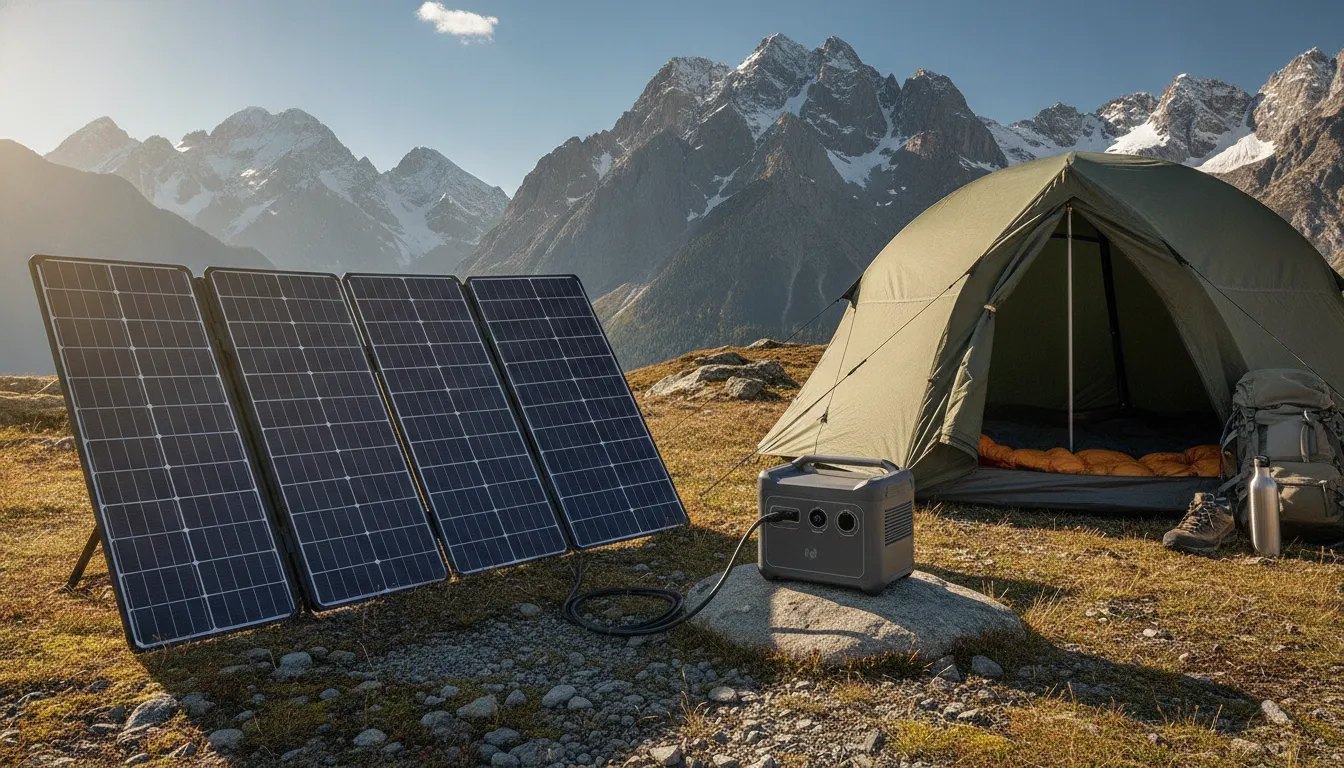
Solar input lets a Portable Power Station recover energy away from a wall outlet. This can be useful for camping, overlanding, emergency readiness, and work away from the grid. A compatible panel does not make runtime unlimited. The station's input range, panel output, sunlight, and charging controller all affect how quickly energy returns.
What does the solar input rating tell you?
The input rating is the maximum power the station can accept through its solar connection. Panel wattage describes potential panel output, but the station may accept less. Check voltage range, connector type, polarity, maximum accepted wattage, and whether the station includes an MPPT controller. The KEUTEK 300W model supports solar, wall, and car charging with MPPT optimization according to its product specifications.
How should you plan around changing sunlight?
Clouds, shade, panel angle, dust, season, and time of day change solar production. Treat advertised panel wattage as a best-case reference rather than a guaranteed charge rate. Keep essential loads modest while charging and leave battery reserve for weather changes. Review KEUTEK's solar panel guide before pairing a panel and station.
What should you verify before connecting a panel?
Match the panel's voltage and connector to the station's accepted input range. Never connect a panel simply because its plug appears to fit. Confirm the maximum solar wattage, polarity, and controller requirements in the product documentation. Correct matching protects the station and makes the expected charging performance more realistic.
Is the KEUTEK 300W LiFePO4 Station a Good Fit?
The KEUTEK 300W Portable Power Station Max is designed for buyers who want a compact station for camping, road trips, tailgating, festivals, and limited emergency backup. Its 256Wh LiFePO4 battery, 300W pure sine wave inverter, and 600W peak rating create a focused balance of mobility and output. It is not a substitute for a whole-home generator.
The model can power up to six devices simultaneously, subject to the station's total-output limits. KEUTEK lists use cases including phones, laptops, lights, CPAP machines, TVs, fans, air pumps, and small appliances. DC use is recommended for CPAP equipment on the product page. Confirm your device's running and startup requirements before relying on it for medical or emergency use.
What charging options does the KEUTEK model offer?
The station supports wall, car, and solar charging. KEUTEK lists approximately 3.5 to 4 hours for wall or car charging and approximately 4 to 5 hours with one 100W solar panel. Wall charging plus a 100W solar panel takes approximately 2 to 2.5 hours. Actual times vary with conditions, load, and battery state. See the KEUTEK 300W power station guide for related guidance.
When is a larger station the better choice?
Choose a larger Portable Power Station when you need several high-draw devices at once, extended runtime, or appliances with substantial startup demands. A 300W class station fits deliberate charging and selected low-wattage loads. It is not the right choice when your normal combined demand approaches its continuous limit. Size up from your actual load instead of choosing by capacity alone.
See the KEUTEK 300W Portable Power Station Max and compare its LiFePO4 capacity, output, and charging options with your device list.
Frequently Asked Questions
How do you choose the right Portable Power Station?
List the devices you need to run, add their simultaneous wattage, and choose a continuous output rating above that total. Then select enough watt-hours for the desired runtime. Compare surge output, ports, battery chemistry, charging methods, size, and manufacturer limits before buying.
Can a Portable Power Station provide home backup power?
A Portable Power Station can provide limited backup for compatible electronics and small appliances. It is not automatically a whole-home backup system. Check continuous output, surge capacity, runtime, transfer requirements, and device compatibility. Keep essential loads within the station's published limits.
Is LiFePO4 a good battery chemistry for portable power?
LiFePO4 can be a strong fit for buyers who value repeated cycling, durability, and a favorable safety profile. It may weigh more than an NMC design with similar stored energy. Choose based on how often you use the station, how far you carry it, and the product's complete specifications.
Can you recharge a Portable Power Station with solar panels?
Many stations accept solar input, including the KEUTEK 300W model. Charging speed depends on panel output, sunlight, the station's input limits, connector compatibility, and its MPPT controller. Verify voltage and maximum wattage before connecting a panel. Solar charging extends off-grid use, but it varies with conditions.
What can a 300W Portable Power Station run?
A 300W station is best matched with electronics and other devices whose combined demand stays below its 300W continuous rating and 600W peak limit. Phones, laptops, lights, cameras, and selected small appliances may fit. Check running and startup requirements for every device before connecting it.


Leave a comment