

What Is Qi Wireless Charging?

What is Qi wireless charging? It is the open wireless charging standard from the Wireless Power Consortium, and it lets a certified pad power a certified phone through a coil instead of a cable. Qi is pronounced "chee," from the Chinese word for vital energy. A pad and a phone that both carry the Qi logo can complete a short safety handshake, then move power across a few millimeters of air.
Qi wireless charging uses magnetic induction between two coils. The Wireless Power Consortium launched the standard in 2010. Early pads delivered about 5 watts. Version 1.2, from 2015, opened a path up to 15 watts. Qi2, launched in 2023, adds magnets so the phone sits in the right spot, still at up to 15 watts. Qi2 25W, the public name for specification 2.2.1, launched in July 2025 and adds nearly 70 percent more power. More than 13,000 products are Qi Certified. Only a product that passes an independent lab test may show the Qi or Qi2 logo.
Call (800) 919-0233 to get help matching a Qi charger. You can also see Qi charging options in the multi-device charging mat guide once you know which power level your phone can actually take.
The rest of this guide stays on the standard itself. You will see how the coil handshake works, how the watt profiles differ, and which checks matter before you buy a pad.
What Is Qi Wireless Charging, in Plain Terms?
Qi is a rulebook, not a brand of charger. The Wireless Power Consortium writes it so a pad from one company can charge a phone from another. Without that shared rulebook, each phone maker would need its own pad, and a "wireless" charger would only work with one family of devices.
The consortium launched Qi in 2010. Its own history of the specification starts with version 1.0 in July 2010, a transmitter that delivered 5 watts into a receiver. That was enough for a slow overnight top-up. It was not a replacement for a wall charger. Later versions kept older certified products working. A change in the minor version number can add features, but products already certified stay compatible.
Today the consortium says more than 13,000 products are Qi Certified, on its Qi wireless charging overview. That list covers phones, earbuds, watches, and the pads that charge them. The logo is the practical test. If a box shows the Qi or Qi2 mark, the product passed an independent lab. A box that only says "wireless" or "Qi compatible" has not made that promise.
Who runs the standard
The Wireless Power Consortium is the standards group behind Qi. It was founded in 2008 and represents more than 300 member companies. Members build the transmitters and receivers. Independent labs test them. The consortium does not sell chargers, because its job is the specification, the test, and the logo.
That split matters when you shop. A KEUTEK pad is useful because it is built to the same coil and safety rules as the phone in your pocket, not because the logo is a style choice. The same is true of any other certified pad.
How Does Qi Wireless Charging Move Power?
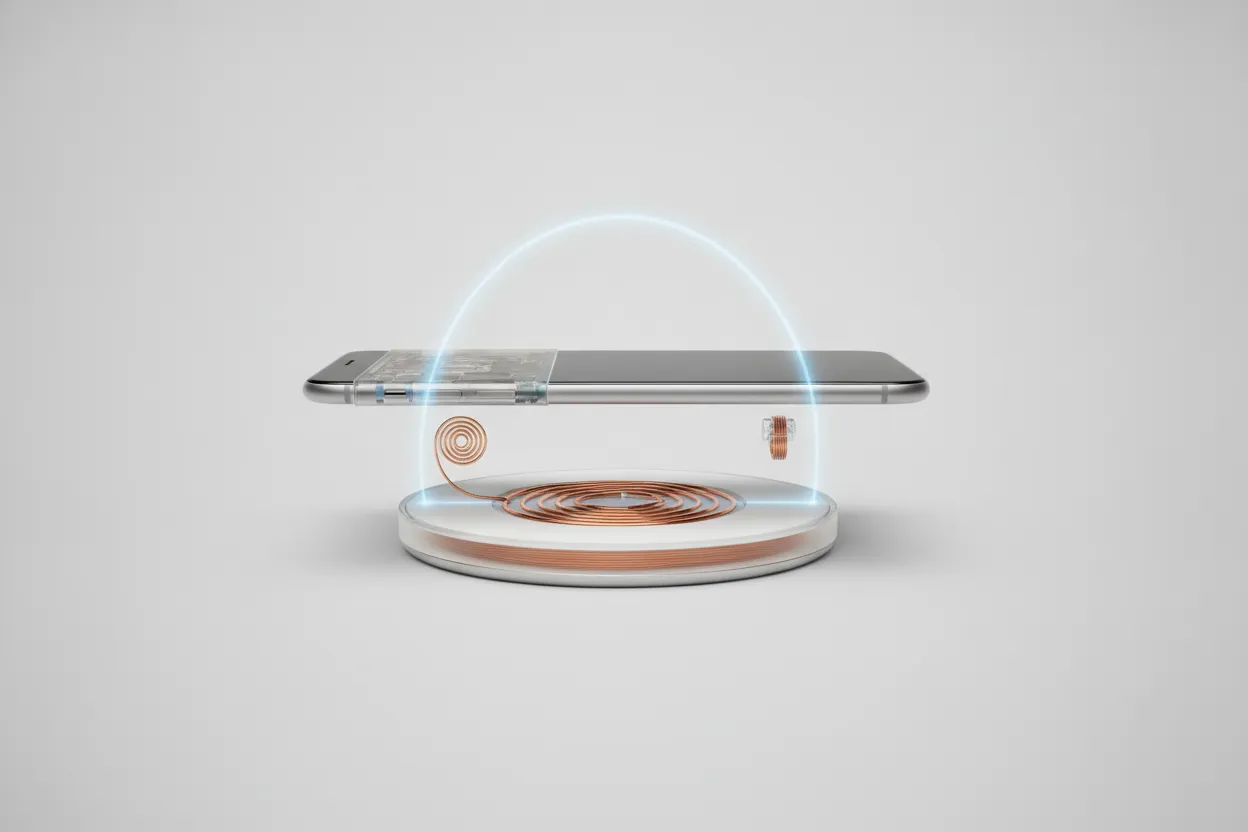
A Qi pad and a Qi phone each hide a coil of wire. When the pad is plugged in, its coil makes a changing magnetic field. Hold the phone's coil in that field and the field pushes current into the phone's coil. The phone turns that current into the direct current its battery expects. The Wireless Power Consortium calls this magnetic induction. Nothing visible jumps the gap between those two coils.
The gap has to stay small. A few millimeters of air, plastic, or a thin case is normal. A thick case, a metal plate, or a phone sitting half off the coil weakens the field. Power drops, heat rises, and the pad may stop charging until you reseat the phone. That is why alignment is the whole game with classic Qi.
The handshake before any power flows
The pad does not dump power into whatever metal lands on it. It sends a small ping, then waits. A Qi receiver answers with a signal the pad can read. The two sides confirm that both are part of the system, agree on how much power to use, and keep talking while charging. If the phone slides away, or a coin covers the coil, the pad should cut power.
Foreign object detection is the safety piece of that talk. The consortium added more sensitive detection in version 1.1 in March 2012, then tightened it again in version 1.2 in October 2015 and version 1.3 in January 2021. The point is simple. A key, a coin, or a foil-backed card should not heat up on a live pad. Version 1.3 also added a way for a phone to check that a transmitter is genuine Qi Certified gear.
- Plug the pad into a wall adapter that can supply the wattage printed on the pad.
- Set the phone flat so its coil sits over the pad's coil.
- Wait for the handshake. Charging starts only after the phone identifies itself.
- Leave the phone still. A shift off the coil slows the charge or stops it.
- Pick the phone up when you need it. The pad drops power when the receiver leaves.
Related products

Adaptive technology throttles 1-5 amp charging output based on your device.
View productWhat Do the Qi Power Levels Actually Mean?
Wattage on the box is a ceiling, not a promise. The phone, the pad, and the wall adapter all have to agree. A 15 watt pad on a 5 watt adapter will not reach 15 watts. A phone whose receiver tops out at 7.5 watts will not take 15 watts from any pad.
The consortium's own version history is the clean way to read those numbers. Version 1.0 delivered 5 watts. Version 1.2, in October 2015, let transmitters offer up to 15 watts and let receivers ask for up to 15 watts. People call the lower path the baseline profile and the higher path the extended profile. You do not need the jargon. You need the number your phone can accept.
| Profile | What the consortium published | What you should expect |
|---|---|---|
| Qi 1.0 baseline | 5 watts into the receiver, from July 2010 | A slow top-up. Fine for overnight, poor as your only charger. |
| Qi 1.2 extended | Up to 15 watts offered and requested, from October 2015 | The common "fast" Qi pad. Speed still depends on the phone. |
| Qi2 magnetic | Magnetic Power Profile, launched in 2023, up to 15 watts | Magnets pull the phone onto the coil. Less hunting for the sweet spot. |
| Qi2 25W | Specification 2.2.1, branded Qi2 25W in July 2025 | Nearly 70 percent more power than original Qi2. Phone support is still new. |
Qi2 is the 2023 jump. The consortium introduced the Magnetic Power Profile in version 2.0 in April 2023, then launched Qi2 in November 2023 with 15 watts and magnetic attachment. Magnets lock the phone on the coil. Alignment stops being a guessing game, so less power turns into heat. The consortium says that within a year there were over 1.5 billion certified Qi2 devices, transmitters and receivers, in the market.
Qi2 25W is newer still. On July 23, 2025, the consortium announced specification 2.2.1 under that brand. It delivers nearly 70 percent more power than the original 15 watt Qi2. The consortium also says a Qi2 25W setup can take a smartphone battery from empty to about 50 percent in about 30 minutes. That figure is the consortium's claim for a certified pair, not a promise for every phone on every pad. Check the phone maker's wireless charging page before you buy a 25 watt pad for a phone that still tops out at 15.
If you want a real-world speed comparison rather than a spec sheet, the wireless versus cable speed test covers that question. The 15 watt wireless charging guide stays on the 15 watt tier this table only names.
How Can You Tell a Pad Is Really Qi Certified?
Look for the logo, then look for a lab, not a slogan. The consortium is direct about this. A product may show the Qi or Qi2 logo only after it passes safety and interoperability tests at an independent authorized lab. Phrases such as "works with Qi," "Qi ready," and "universal wireless" are marketing lines. They are not the same thing as the certified logo.
Certification is what makes a pad from one brand charge a phone from another. The test checks the handshake, the power limit, heating, and foreign object detection. Skip the logo and you are trusting the seller's word on all four.
Checks before you buy
- The Qi or Qi2 logo is printed on the pad or the box, not only in a product title.
- The wattage matches the phone. A higher number on the pad does not raise the phone's limit.
- The wall adapter can feed the pad. A pad rated 15 watts needs a strong enough USB-C adapter.
- Your case is thin and non-metal. Metal plates and thick wallets block the coil.
- The pad has a foreign-object cutout. Coins and keys should not get hot if they land on it.
Phone-by-phone support changes with the model year. Use the any-phone wireless charger guide for that check, and the tablet charging pad guide if the device is a tablet rather than a phone. This page does not keep a model list, because those lists go stale.
Which Qi Charging Pad Should You Actually Use?
Match the pad to the way you charge, not to the biggest number on a box. A single phone on a nightstand needs a different pad than a desk that also holds earbuds. The standard decides whether the phone and pad can talk. Your routine decides the shape.
For one phone, a certified 15 watt pad is the useful default in 2026. Qi2 is worth it when the phone has magnets, because the phone snaps into place and stays there. Buy a Qi2 25W pad only when the phone maker says that model can take it. Otherwise you pay for a ceiling the phone will not use.
For a desk with a phone plus earbuds or a watch, a single coil is the wrong tool. You want a mat with more than one charging spot, and you still want each spot to be Qi or Qi2 certified. That comparison lives in the charging mat guide, which is the next page if you are shopping rather than learning the standard.
Compare Qi charging options for several devices before you pick a mat, including which pads keep a phone, earbuds, and a watch charging at the same time. Questions about a specific phone are a call to (800) 919-0233 away.
KEUTEK sells a 15W fast wireless charging pad for the single-phone case. It sits at the 15 watt extended profile most current phones can use. Some days a cable is still the faster choice, especially for a laptop. The fast wireless charging guide connects the pad choice to the rest of a KEUTEK setup. The wireless charging phones guide is the page for how a phone receives power, which this article treats as background.
Frequently Asked Questions
What is Qi wireless charging in one sentence?
Qi wireless charging is the Wireless Power Consortium standard that moves power from a certified pad to a certified phone through two coils, after a short safety handshake.
Is Qi the same thing as MagSafe?
No. MagSafe is Apple's magnetic accessory system. Qi2 is the consortium standard that added a Magnetic Power Profile in 2023 so certified phones and pads can snap into alignment. A MagSafe phone can use many Qi2 pads. A Qi2 logo, not the word MagSafe, is what tells you a pad passed the consortium's test.
Does Qi wireless charging wear out the battery?
Heat is the real issue, not the coil itself. A phone that sits off-center on a classic Qi pad runs warmer. Qi2's magnets cut that misalignment. Foreign object detection, tightened across versions 1.1, 1.2, and 1.3, is there so loose metal does not heat up on the pad. Use a thin non-metal case and a certified pad.
Can a 25 watt Qi2 pad charge an older Qi phone?
Yes, at the older phone's own limit. The consortium versions stay backward compatible. A Qi2 25W pad can still charge a phone that only accepts 5 or 15 watts. It will not force 25 watts into a receiver that never asks for them.
Why does my phone get hot on a wireless pad?
The coil is off-center, the case is too thick, or something metal is between the phone and the pad. Reseat the phone, remove metal plates, and confirm the pad shows a Qi or Qi2 logo. If it still runs hot, stop using that pad.


Leave a comment