

Waterproof Power Bank Ratings: A Practical Guide

A waterproof power bank can keep essential devices charged through rain, spray, and accidental immersion, but only within the limits of its tested IP rating. The most useful buying clue is not the word "waterproof" on a product page. It is the exact Ingress Protection code, the manufacturer's test conditions, and the condition of the seals protecting the charging ports.
Explore KEUTEK fast-charging portable power for travel, outdoor use, and emergency readiness.
Quick answer: Choose IP65 or IP66 for rain and spray. Choose IP67 when accidental short-term immersion is a realistic risk. Consider IP68 only after checking the maker's stated depth and duration. No rating makes a power bank safe to charge while wet, and an open port cover can defeat the enclosure's protection.
What does waterproof mean for a power bank?
For portable electronics, waterproof should describe tested resistance to liquid entering the enclosure. The relevant measurement is an IP rating defined under IEC 60529 by the International Electrotechnical Commission. A rating gives buyers a consistent way to compare enclosures, but it does not promise protection in every wet situation.
An IP code has two digits. The first describes protection against solid particles, such as dust and sand. The second describes protection against water. IP67, for example, indicates the highest dust-protection level in this system and protection against temporary immersion under specified test conditions.
The details matter because water reaches electronics in different ways. Light rain, a high-pressure jet, and immersion each place different stress on a seal. A model tested for immersion is not automatically certified for forceful water jets, and the reverse is also true. Read the complete rating rather than assuming a higher final number covers every lower-numbered test.
Water-resistant and waterproof are not interchangeable
Water-resistant usually means a device can tolerate limited exposure, such as splashes or brief rain. Waterproof is commonly used for stronger protection, but marketing language alone does not tell you the test method. A specific IP code is more useful than either label.
A protective case also needs to keep water away from the battery cells, circuit board, and ports. Moisture in a connector can lead to corrosion or electrical damage. Never connect a cable or attempt to charge a power bank until the device and its ports are completely dry.
How do you read waterproof power bank IP ratings?
Start by separating the two digits. In IP67, the "6" means the enclosure is dust-tight. The "7" means it was tested for temporary immersion in fresh water, generally up to one meter for 30 minutes. An "X" in either position means that part of the protection was not assigned a rating.
| Rating | Dust protection | Water test | Practical fit |
|---|---|---|---|
| IP65 | Dust-tight | Water jets | Rain, splashes, and routine outdoor use |
| IP66 | Dust-tight | Powerful water jets | Heavy spray and harsher storms |
| IP67 | Dust-tight | Temporary immersion | Camping near streams or accidental drops |
| IP68 | Dust-tight | Continuous immersion under maker-stated conditions | Use cases requiring stronger immersion protection |
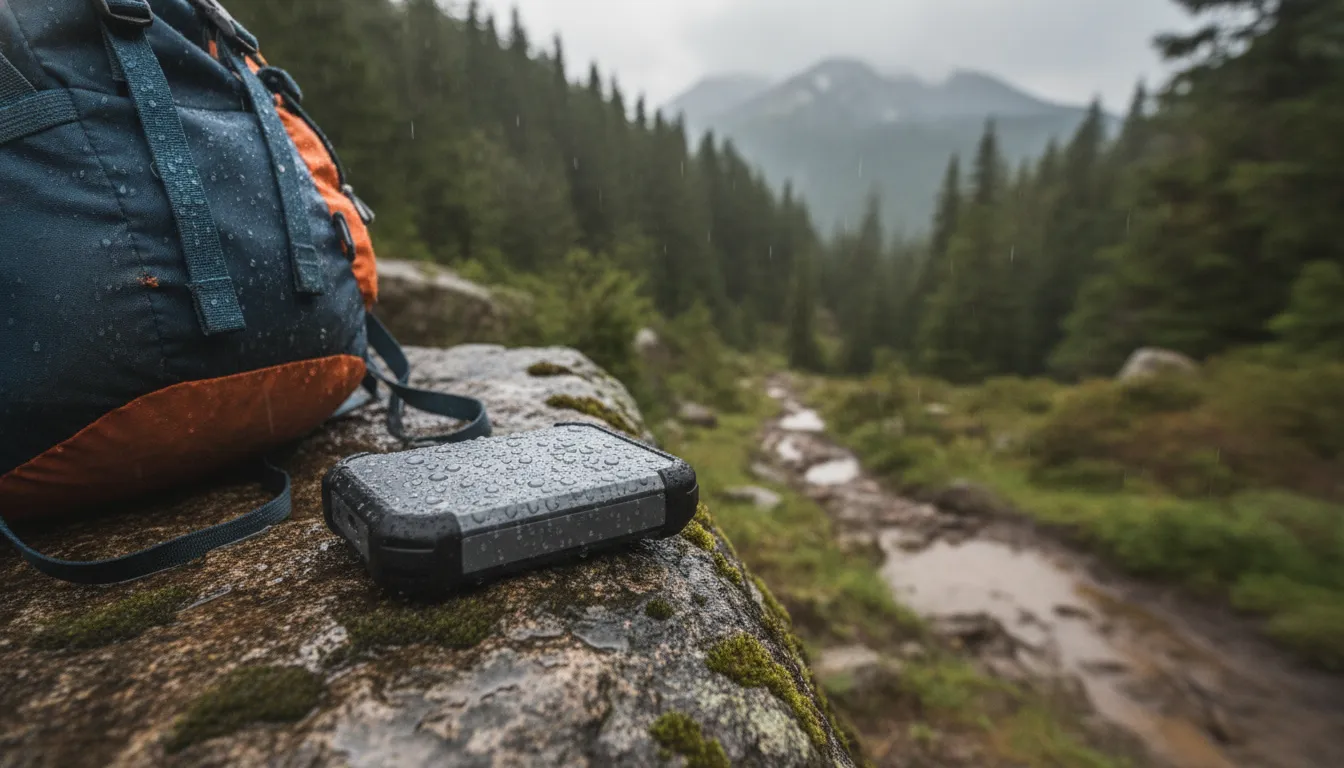
IP68 deserves extra attention because the precise immersion depth and duration are set by the manufacturer and should be stated in the product documentation. Do not assume every IP68 product has the same limits. Compare the stated conditions before choosing one for boating, paddling, or repeated wet-weather use.
Why the enclosure and port covers matter
The enclosure only performs as rated when all covers and seals are properly seated. Sand, lint, or a damaged gasket can create a path for moisture. A loose port flap can also make the printed rating irrelevant in real-world use.
Inspect covers before each trip. Press them completely into place, and avoid opening them in rain. If you need power while conditions are wet, keep the power bank and cable connection inside a dry bag or another sheltered space.
Water-resistant vs. waterproof power banks
The right choice depends on the exposure you reasonably expect. A commuter who wants protection from a leaky bottle has different needs from a paddler who could drop gear overboard. Buying for the actual risk is more useful than automatically choosing the highest rating.
When water resistance may be enough
For commuting, air travel, and casual day trips, protection from rain or splashes may be sufficient. An IP65 or IP66 enclosure can be a practical fit when immersion is unlikely. Store it in a separate pocket and keep liquids away from open connectors.
When immersion protection is worth considering
Hikers, campers, anglers, and emergency-preparedness users may face a realistic chance of dropping a device in shallow water. IP67 provides a clearly defined temporary-immersion benchmark. It can add confidence, but it still does not excuse careless handling or wet charging.
For long periods near water, use layers of protection. Place electronics in a dry bag even when their enclosure has a strong rating. This protects the power bank from conditions that laboratory tests may not reproduce, including repeated impacts and contaminated water.
What an IP rating does not guarantee
An IP rating is valuable, but it is not an all-purpose durability score. It does not automatically cover drops, salt water, chemicals, extreme heat, or years of seal wear. It also does not confirm charging speed, battery capacity, or device compatibility.
Salt water, mud, and contaminated water
Immersion tests commonly use fresh water under controlled conditions. Salt water can accelerate corrosion, while mud and grit can interfere with port covers. If the device is exposed to either, follow the manufacturer's cleaning guidance and do not open or use a connector until everything is clean and dry.
Age, impacts, and temperature
Rubber seals can harden or crack over time. Drops can deform the case or shift a cover. Heat can also accelerate wear and stress the battery. Inspect a frequently used power bank rather than treating its original rating as a permanent guarantee.
Charging while wet
A rated enclosure may depend on closed port covers. Connecting a cable opens that barrier. Keep charging ports dry, and never plug in a cable when moisture is present. This is especially important during storms, when finding shelter before connecting devices is the safer choice.
See KEUTEK's portable solar power bank for an outdoor-ready charging option.
Which protection level fits your use case?
Use your environment to narrow the options, then compare capacity, output, size, and compatibility. The ideal waterproof power bank is not simply the one with the highest IP number. It is the one that provides enough protection and usable power without adding unnecessary weight.
Commuting and travel
For everyday bags and flights, focus on protection from splashes, a secure enclosure, and a practical size. Keep the unit away from loose liquids and use a protective pouch. Confirm current airline rules before packing any lithium-ion power bank for a flight.
Hiking and camping
For trails and campsites, dust protection, secure port covers, and resistance to temporary immersion can be useful. IP67 is a practical benchmark when streams, rain, or wet ground are part of the trip. Pair it with a dry bag rather than relying on one layer of protection.
Boating and emergency kits
For boating, examine the maker's salt-water guidance and exact immersion limits. A floating dry bag can be more important than moving from one IP rating to another. For emergency kits, inspect and recharge stored power banks on a schedule so they are ready when needed.
How to choose a waterproof power bank
Once you understand the rating, evaluate the power bank as a complete charging tool. A tough enclosure is helpful only if the device can support the electronics you plan to carry.
- Define the likely exposure. Decide whether you need rain protection, resistance to water jets, or temporary immersion protection.
- Verify the complete IP code. Look for a specific rating and read the maker's stated test limits, especially for IP68.
- Inspect the port-cover design. Choose covers that close securely and are easy to check for debris or damage.
- Match capacity to the trip. Estimate how many devices and recharges you need, then balance capacity against pack weight.
- Check output and compatibility. Confirm that the ports and charging protocols support your devices.
- Plan a dry charging setup. Carry a dry bag or sheltered pouch so connections remain protected in bad weather.
KEUTEK offers fast-charging portable power options for keeping devices ready at home and away. For larger emergency and off-grid loads, compare the capabilities of a portable power station with those of a pocket-size power bank.
Compare KEUTEK fast-charging portable power for your next trip or emergency kit.
How to care for a waterproof power bank
Good care preserves the seals that make water protection possible. Before each use, check the case for cracks and inspect port covers for grit, lint, or deformation. Clean only according to the product instructions, and allow the unit to dry completely before opening a cover.
- Keep every port cover fully closed around water.
- Store the power bank in a cool, dry location away from direct heat.
- Do not charge the unit or a connected device while ports are wet.
- Use a dry bag for an extra barrier during boating and heavy rain.
- Stop using the power bank if the case swells, cracks, or becomes unusually hot.
A waterproof rating is a risk-control tool, not permission to leave electronics exposed. Treating the enclosure carefully helps it remain dependable through changing weather and repeated trips.
Make seal inspection part of your packing routine. Test the power bank before leaving home, confirm that every cable fits securely, and pack a backup charging plan for longer trips. If a cover no longer closes flush or the case has taken a hard impact, keep it away from water until it can be assessed. Small checks take little time and reduce the chance of losing communication, navigation, or emergency power when conditions become difficult.
Frequently asked questions
What does an IP67 rating mean for a power bank?
IP67 means the enclosure is dust-tight and was tested for temporary immersion in fresh water up to one meter for 30 minutes under controlled conditions. The rating assumes covers and seals are correctly closed.
Are all rugged power banks waterproof?
No. Rugged usually describes resistance to impacts or rough handling. Waterproof performance should be supported by a specific IP rating. Check both if you need protection from drops and water.
Can I use a waterproof power bank in the rain?
Only within the manufacturer's stated limits. Opening a port cover to connect a cable may compromise the rated seal. Keep the connection sheltered and dry, and never connect a cable to a wet port.
How do I maintain a power bank's waterproof seal?
Keep port covers clean and fully closed, inspect gaskets for damage, and let the device dry completely before charging. Follow the manufacturer's care instructions after exposure to salt water or mud.
Choose portable power for the conditions ahead
The best waterproof power bank matches a verifiable IP rating to the environment where you will use it. Check the exact code, understand its limits, and protect open connections from moisture. Those habits make it easier to keep essential devices powered without asking a rating to do more than it was designed to do.
Shop KEUTEK fast-charging portable power for your next trip or emergency kit.


Leave a comment