

Heavy Duty Power Bank Guide for Work and Emergencies

A heavy duty power bank keeps essential electronics running when outdoor work, remote travel, or a power outage takes you away from an outlet. The right model balances usable capacity, compatible output, practical weight, and safe storage. It should fit the devices and conditions in your plan, not simply have the largest number on the label.
Explore KEUTEK fast portable power for dependable charging away from an outlet.
This guide explains how to estimate capacity, choose useful charging features, compare field-work and emergency-kit priorities, and maintain a portable battery so it is ready when needed.
What makes a power bank heavy duty?
A heavy duty model combines enough usable energy for priority devices with useful ports, dependable charging, and a build suited to frequent transport. It should also be easy to inspect, recharge, and organize. A huge capacity rating alone does not make a battery the best choice for demanding use.
Capacity that matches a real plan
Capacity is commonly shown in milliamp-hours, or mAh. That figure helps compare batteries, but it does not tell you exactly how many complete charges you will receive. Energy is lost during voltage conversion and charging, and results vary by device, cable, temperature, and use.
Start with the electronics that matter most. A field kit might prioritize a phone, GPS unit, headlamp, and tablet. An emergency kit might prioritize household phones, rechargeable lights, and a radio. Estimate how often each device must be recharged, then include a reserve for delays or heavier-than-expected use.
Outputs and ports that fit your equipment
A large battery can still be frustrating if its ports do not match your equipment. Check both the port type and supported output. USB-C Power Delivery can support faster charging for many compatible phones, tablets, and laptops, while USB-A remains useful for older accessories.
Also check how the power bank behaves when several ports are used together. The maximum output of one port may differ from the total output shared across all ports. If several people or devices rely on the same bank, simultaneous-use performance matters more than a single peak figure.
A design you can carry and protect
Heavy duty does not have to mean unnecessarily heavy. More stored energy usually adds size and weight, so capacity must be balanced against portability. A battery that stays at home because it is too bulky cannot help a mobile crew. A battery that is too small may not provide a meaningful emergency reserve.
Look for a housing and port design suited to the intended environment, then protect the unit from impacts, standing water, debris, and extreme temperatures. Keep it in a stable compartment where cables and metal objects cannot damage its ports.
How do you size a heavy duty power bank?
Size a heavy duty power bank by listing essential devices, estimating how many recharges each one needs, and adding a reserve. Use watt-hours when available because they make it easier to compare devices with different voltages. Treat the advertised capacity as a planning reference, not guaranteed usable output.
Build a device inventory
Write down every device that must stay available. Separate essential equipment from convenience items so limited energy can be rationed intelligently. For each essential device, note its battery capacity or watt-hour rating and the number of full or partial recharges you expect to need.
For outdoor work, base the estimate on the longest shift or trip between reliable outlets. For emergencies, decide how many days the kit must support and which devices may be powered down between uses. This inventory prevents both underbuying and carrying more battery than the situation requires.
Calculate a practical reserve
Add the energy needs for all priority devices, then include a reasonable reserve for conversion losses, cold weather, detours, or a longer outage. The reserve should improve resilience without turning a portable kit into an immovable one. If the estimate becomes too large, reduce consumption before increasing battery size.
- List the devices that must remain operational.
- Record each device's battery capacity or watt-hour rating.
- Estimate the required number of recharges.
- Add the energy needs for all priority devices.
- Include a reserve for losses and unexpected use.
- Confirm that the final battery size is practical to carry and store.
Test the complete charging setup
A paper calculation is only the first step. Charge every planned device from the selected power bank using the exact cables that will be stored in the kit. Confirm that charging starts normally, ports fit securely, and the bank can support the intended routine.
Record the result and adjust the plan if the battery empties too quickly or takes too long to recharge. A real test reveals weak cables, missing adapters, incompatible ports, and unrealistic capacity assumptions before they become field problems.
Review KEUTEK's portable solar power bank for an active outdoor-power option.
Outdoor work vs. emergency kit requirements
Outdoor-work kits and emergency kits both need reliable portable power, but their priorities differ. Field crews often value fast daily charging, easy transport, and repeated use. Emergency kits need organized storage, simple operation, and enough reserve to support essential communications and lighting during an outage.
| Decision factor | Outdoor work kit | Emergency kit |
|---|---|---|
| Primary goal | Keep daily equipment working between outlets | Maintain essential electronics during an outage |
| Typical use | Frequent, planned charging | Occasional, unpredictable charging |
| Portability | High priority for mobile crews | Balanced with required reserve |
| Storage | Protected compartment in a work bag or vehicle | Cool, dry, accessible emergency-kit location |
| Maintenance | Checked during routine use | Inspected and tested on a schedule |
Priorities for field crews
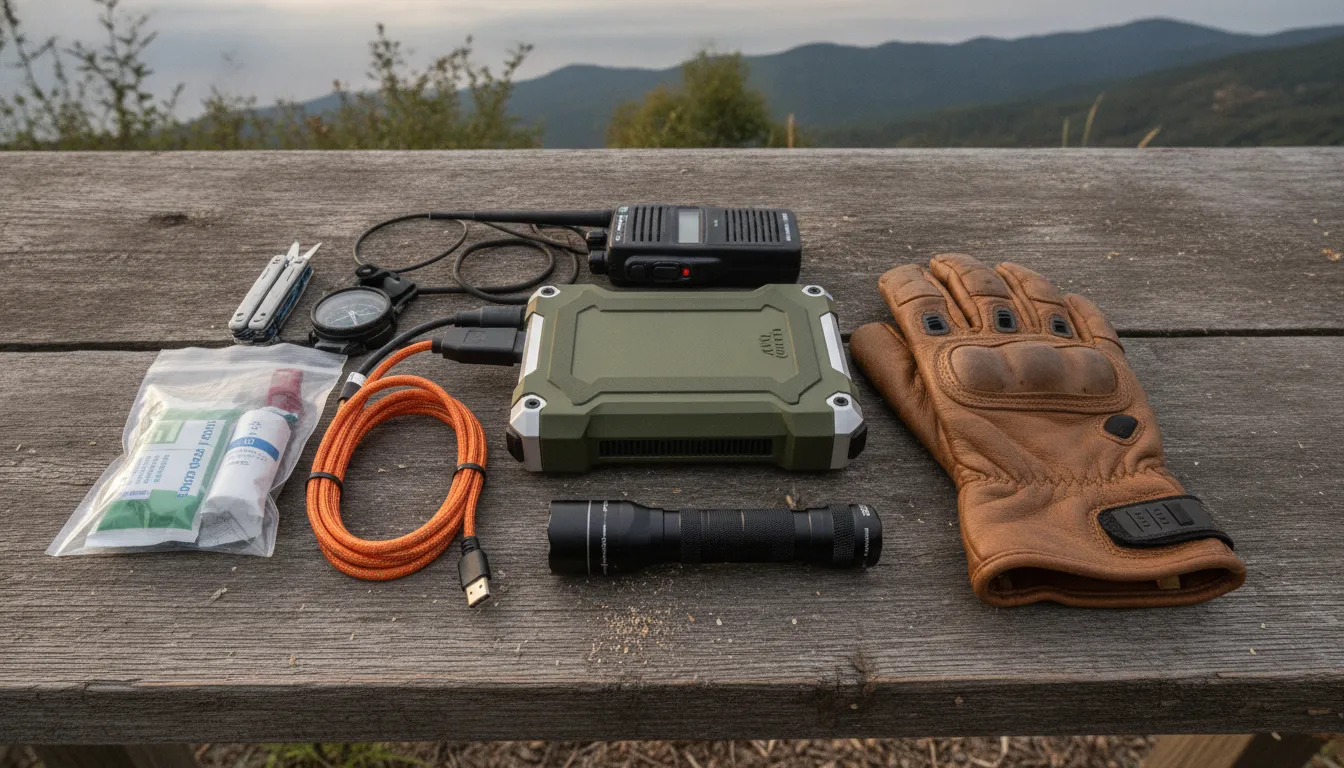
Field crews should start with the equipment that directly supports safety, communication, navigation, and the day's work. Port placement, recharge speed, weight, and ease of packing may matter more than maximum capacity. A smaller bank that can be carried and recharged every day may outperform a larger unit that is difficult to manage.
Keep the bank out of direct sun and away from loose tools that could strike or puncture it. At the end of a shift, inspect the case and ports, check the remaining charge, and restore the kit for the next day.
Priorities for emergency preparedness
An emergency kit should be simple enough for household members to use under stress. Label the compatible cables, group related gear, and include a short device-priority list. Store the battery where it can be reached safely without searching through unrelated supplies.
Portable power is one layer of an emergency plan, not a replacement for broader preparation. Conserve energy by lowering screen brightness, using devices only when needed, and turning off radios and lights between check-ins.
Which charging features matter most?
The most useful charging features are those that match the devices and routines in your kit. Compatible USB-C charging can reduce waiting, multiple ports improve flexibility, and a clear battery indicator helps ration energy. Reliable cables and an appropriate wall charger complete the system.
USB-C Power Delivery and port compatibility
USB-C Power Delivery allows compatible chargers and devices to negotiate an appropriate power level. It is useful for many newer phones, tablets, and laptops, but both the bank and the device must support the required charging profile. Review the specifications for every critical device instead of assuming that any USB-C port will deliver the same result.
Cables are part of the compatibility chain. Use a cable designed for the intended connector and charging requirement. For equipment that fits its supported use, a KEUTEK ProSeries Max fast-charging cable can help keep a charging kit organized and ready.
Recharge speed and shared output
Consider how the power bank itself will be recharged. A high-capacity unit with a slow input can remain unavailable for too long between shifts or outages. Match the bank with a compatible charger, then test the time required to restore it from the level at which you normally begin recharging.
If several devices will charge at once, confirm the total shared output. Some banks reduce the output available to each port during simultaneous use. Decide whether the kit needs to charge several devices slowly or one priority device quickly, then test that exact scenario.
Useful supporting accessories
Keep only the accessories the plan requires. Include compatible cables, a suitable charger, and any necessary adapters. Remove damaged or duplicate items that add clutter without improving readiness. A labeled pouch can prevent cables from becoming separated from the battery.
At home or at a reliable base, a compatible option from KEUTEK's fast wall charger collection can support the recharge routine. For vehicle-based work and travel, review whether the KEUTEK fast-charging car charger fits the devices and vehicle in your plan.
How should you store and maintain a power bank?
Store a power bank in a cool, dry place away from direct sun, moisture, metal objects, and physical pressure. Inspect the housing, ports, and cables regularly, then recharge and test the unit according to the manufacturer's instructions. Stop using a battery that swells, leaks, overheats, or shows damage.
Create a simple inspection routine
Put battery checks on the same calendar used for other work gear or emergency supplies. During an inspection, look for cracks, swelling, damaged ports, frayed cables, unusual heat, or signs of moisture. Confirm the indicator works and that a priority device begins charging normally.
Do not rely on a battery that has sat untouched for a long period. A short scheduled test verifies the battery, cable, and device as one complete system. Replace damaged components rather than returning them to the kit.
Protect the battery in the field
Place the bank in a secure, ventilated part of the kit. Keep it away from sharp tools, direct sun, standing water, and locations where it can be crushed. Do not cover a battery that is becoming unusually hot during use or charging.
When conditions are wet or dirty, handle the bank with clean, dry hands and protect open ports. If the unit is exposed to conditions outside its instructions, stop and assess it before reconnecting equipment.
Organize for fast decisions
Label each cable by device or connector, and place the device-priority list where it can be seen immediately. Record the most recent inspection date and any replacement needs. Good organization reduces wasted time and prevents scarce stored energy from being spent on low-priority equipment.
For emergency kits, ensure other household members know where the power bank is stored and which devices take priority. For crews, assign responsibility for end-of-shift inspection and recharging so readiness does not depend on assumptions.
Heavy duty power bank buying checklist
The best heavy duty power bank is the one that supports the right devices, fits the kit, and can be maintained consistently. Compare usable capacity, compatible output, port mix, size, weight, and recharge routine. Test the complete setup before relying on it for work or emergencies.
- Devices: Does it support every essential phone, light, radio, tablet, or laptop?
- Capacity: Is there enough reserve for the planned duration without excessive weight?
- Ports: Do the connector types and shared output match the charging plan?
- Recharge plan: Can the bank be restored within the available time?
- Transport: Is it practical to carry and protected from impact and moisture?
- Maintenance: Is there a clear inspection, testing, and replacement routine?
Build a more dependable charging kit with KEUTEK fast portable power.
Frequently asked questions
Is a very large power bank necessary?
Not for every kit. A larger battery offers more reserve but also adds weight, bulk, and recharge time. Start with the essential devices and expected duration, then choose enough capacity to cover that plan with a reasonable reserve.
Are heavy duty power banks worth it for emergency kits?
They can be valuable when phones, lights, radios, and other small electronics matter during an outage. A power bank should be one part of a broader preparedness plan, stored safely and tested regularly with the devices it is expected to support.
Can I take a power bank on a plane?
Travel rules and airline requirements can change. Confirm current rules before each trip, check the watt-hour rating printed on the battery, and contact the airline when limits or approval requirements are unclear.
How often should I check a stored power bank?
Follow the manufacturer's storage and charging instructions. Inspect and test the battery on a regular schedule, and replace it if it swells, leaks, overheats, or develops visible damage.


Leave a comment