

Fast Car Charger Voltage: 12V vs 24V Explained

Car chargers do not pull a single, perfectly constant voltage from the vehicle. A typical passenger-car accessory socket supplies about 12V DC, with the reading often rising to roughly 13.5V to 15V while the engine runs. Heavy-duty trucks may use sockets near 24V DC, so the vehicle type matters before you choose a charger.
Fast car charger voltage starts with the vehicle's 12V or 24V electrical system. Then a DC-DC converter and USB-C Power Delivery negotiation deliver the stable voltage your device requests, such as 5V, 9V, 15V, or 20V. That process lets one charger support different devices without sending the full socket voltage directly to them.
The important distinction is between the socket's input and the regulated output at the USB port. Understanding that distinction makes it easier to compare chargers, check compatibility, and interpret wattage claims without relying on guesswork. Start with how the vehicle socket is wired and what its voltage means in everyday use.
Explore the KEUTEK 78W Fast Charging Car Charger for dependable fast charging on the road.
What Voltage Does a Car Charger Use?
Most passenger vehicles supply approximately 12V DC through the accessory power socket. That reading is not perfectly fixed. With the engine running and the charging system active, the socket can rise to roughly 13.5V to 15V. Heavy-duty trucks may use an electrical system closer to 24V DC instead. These differences matter because the charger must be designed for the vehicle's input range, not just the label on the socket.
The USB output is a separate stage. A car charger uses a DC-DC converter to accept the vehicle's varying electrical input and produce a stable USB output, commonly 5V, 9V, or 12V. That conversion lets a connected phone, tablet, or other device receive the voltage it is designed to use rather than the raw voltage coming from the vehicle.
How the Vehicle Input Becomes Stable USB Power
Think of the charger as an electrical translator. On the input side, it connects to the vehicle's accessory circuit. On the output side, it supplies controlled power through USB. The converter manages the difference between the vehicle's changing voltage and the device's charging requirements.
For standard charging, the charger may provide 5V USB power. Compatible fast-charging systems can use higher negotiated output levels, such as 9V or 12V, when the charger and device support them. The important distinction is that these are regulated USB outputs, not a direct pass-through of the car's 12V or 24V system. A well-designed charger keeps the output within the range its connected device expects.
That is why the phrase fast car charger voltage refers to two related specifications: the input voltage the charger can accept and the output voltage it can deliver. Passenger-car and truck applications should not be treated as interchangeable unless the charger's specifications explicitly support both. For everyday passenger vehicles, choosing a charger built for the vehicle's accessory system and its intended USB charging standard provides the right foundation for reliable power on the road.
Source: automobile auxiliary power outlet voltage reference. The DC-DC conversion description is supported by this USB car charger technical guide.
12V vs 24V: How Car Electrical Systems Differ
The key difference is the vehicle platform. Most passenger cars use a 12V electrical system, while many trucks and heavy commercial vehicles use a system near 24V. That distinction matters when choosing a fast car charger voltage. Because the charger must be designed for the vehicle's input range rather than simply matching the USB output your phone or laptop needs.
A typical 12V accessory circuit is protected by a fuse rated at approximately 10 to 20 amperes. In simple terms, that represents about 120 to 240 watts of circuit capacity. Although the practical limit for a specific vehicle depends on its fuse, socket, wiring, and manufacturer guidance. The outlet may also sit above nominal voltage while the engine is running, so a compatible charger needs input regulation and protection.
| Electrical characteristic | 12V passenger cars | 24V commercial vehicles |
|---|---|---|
| System voltage | Approximately 12V DC at the auxiliary outlet | Near 24V DC in many trucks and heavy-duty vehicles |
| Typical current protection | Often a 10-20A fuse on the 12V accessory circuit | Varies by vehicle and installed circuit; confirm the vehicle specification |
| Common use | Passenger cars, SUVs, vans, and personal travel | Trucks, heavy commercial vehicles, and some fleet equipment |
These figures describe the vehicle-side supply, not the voltage delivered directly to a connected device. A car charger functions as a DC-DC converter. It accepts the vehicle's electrical input and provides a controlled USB output, with charging standards determining what the connected device receives. That conversion is why a properly specified charger can support modern phones and other devices without exposing them to the vehicle's raw system voltage.
For a passenger car, the 78W fast car charger is a practical option for high-speed mobile charging on the road. If you are comparing options for home, travel, or a mixed-use setup, browse the wall and car chargers collection. For trucks or commercial fleets, verify that the charger explicitly supports the vehicle's input voltage before installation. Never assume that a 12V-only model is suitable for a 24V system just because the connector fits.
Source context: auxiliary outlet voltage and fuse capacity are documented by Automobile Auxiliary Power Outlet.
How USB-C Power Delivery Negotiates the Right Voltage
USB-C Power Delivery does not simply send the highest voltage a charger can produce. It uses a controlled exchange between the charger, the cable, and the connected device. That negotiation lets a phone request a level it can use while a laptop requests substantially more power from the same charger. The result is faster charging without treating every device as if it had identical electrical requirements.
- The charger announces its available power. When connected, a USB-C PD charger communicates the voltage and current combinations it can provide. These options are called Power Data Objects, or PDOs. A basic charger may advertise fixed PDOs such as 5V, 9V, 15V, and 20V. The older 12V fixed option is now deprecated in the original PD framework. This gives the device a clear menu of supported operating points instead of leaving voltage selection to guesswork. Acroname's USB PD negotiation overview explains how these objects describe the charger's capabilities.
- The device identifies what it can accept. The connected phone, tablet, computer, or other equipment evaluates the advertised PDOs against its own charging circuitry, battery state, thermal limits, and cable capabilities. A phone may accept approximately 9V at 3A, while a capable laptop may use 20V at 5A. Those are examples of different power needs, not commands that every device will request.
- The device requests a compatible PDO. After comparing its requirements with the charger's offers, the device sends a request for one supported voltage and current combination. If the charger cannot provide the requested option, the device must choose another available profile, commonly falling back to a lower-power mode. This is why a high-wattage charger can safely charge a smaller device: the device controls the request within the negotiated limits.
- The charger accepts and switches output. The charger confirms the request, adjusts its conversion stage, and supplies the agreed voltage and current. It does not apply 20V to the device before this exchange is complete. Ongoing communication can also support changes as conditions shift, such as when a battery nears full charge or thermal limits require less power.
- The system stays within the applicable standard. USB-IF maintains the USB Power Delivery specification, which is designed to support interoperable fast charging. PD Revision 3.1 expanded the standard to as much as 240W over a fully featured USB-C cable and connector. Adding fixed 28V, 36V, and 48V levels for higher-power equipment. The exact limit still depends on the charger, cable, and device. For everyday car charging, the important principle is the same: the source and device settle on a supported profile rather than exposing the device to an uncontrolled voltage. USB-IF's USB Power Delivery overview documents these capability and power-level updates.
That negotiation is the technical reason a fast car charger can serve different devices from one USB-C port. The vehicle supplies the charger's input, while PD manages the device-facing output with a defined, device-specific agreement.
How to Read Wattage Output on a Fast Car Charger
Wattage tells you how much power a charger can deliver, but the number only makes sense when you understand the voltage and current behind it. The basic relationship is simple: watts = volts x amps. A charger delivering 5 volts at 3 amps supplies 15 watts. Raise the voltage while keeping current within a practical range, and the available power increases.
Why USB-C PD raises voltage instead of relying on more current
A vehicle's 12V accessory circuit may be protected by a 10 to 20 amp fuse, representing roughly 120 to 240 watts of circuit capacity. That figure describes the vehicle circuit, not the guaranteed output of the USB ports. The charger still has to convert the vehicle's fluctuating electrical input into controlled USB power, and its ports, components, cable, and thermal design determine the usable output.
Inside a modern fast car charger, USB-C Power Delivery can raise the output voltage above the basic 5V level used by legacy USB charging. Higher voltage allows the charger to deliver more watts without pushing all of the power through higher amperage. USB-IF describes USB PD as a specification for delivering higher power over USB-C, with supported power levels reaching up to 240W in the broader standard. The charger and device negotiate an appropriate combination of voltage and current rather than applying the maximum automatically. USB-IF explains the USB PD specification.
For practical shopping, compare the wattage assigned to each port, not only the headline number on the package. A phone may request a lower power level than a laptop, while a multi-port charger may divide its total output when several devices are connected. The device, charger, and cable must all support the intended charging level for the result to match the advertised capability.
Read wattage as a ceiling, not a promise that every device will draw that much power. A well-designed fast car charger supplies the negotiated level steadily, even as the vehicle's input changes between parked and running conditions. That distinction helps you choose a charger based on real device needs instead of mistaking the vehicle's available current capacity for USB output.
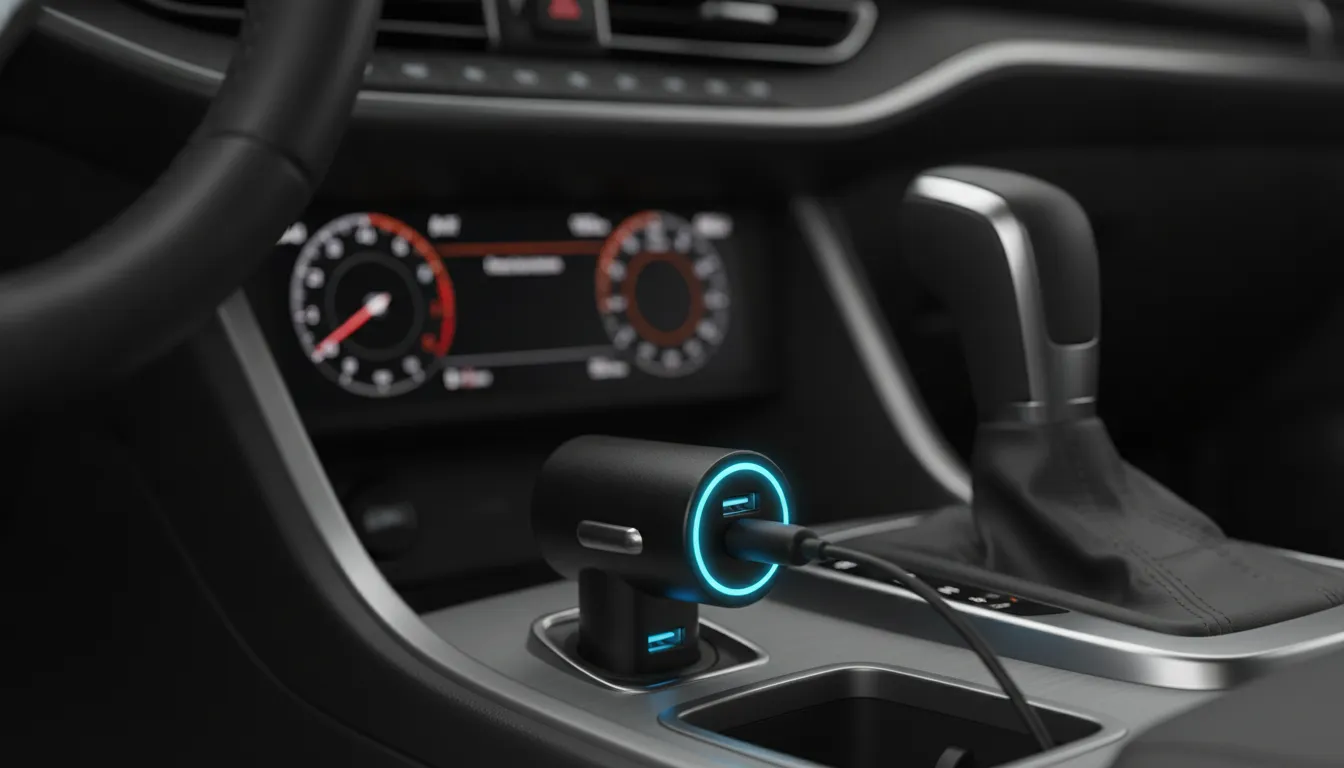
Need a compact fast car charger for everyday drives? Browse the Wall & Car Chargers collection to find one that fits your setup.
Why One Charger Works Across Cars, Trucks, and Fleets
A vehicle fleet rarely has one electrical profile. A pool may include passenger cars, pickups, delivery trucks, service vans, and other commercial vehicles. That variety does not automatically require a different USB charger for every vehicle. The key is choosing a unit designed for the input range used by the fleet.
Passenger vehicles typically provide approximately 12V DC through the auxiliary power outlet. The reading can rise to roughly 13.5V to 15V while the engine is running, as described in the automobile auxiliary power outlet reference. Heavy-duty trucks can use an outlet near 24V DC instead. The input voltage differs, but the connected phone, tablet, navigation unit, or laptop still needs a controlled USB output.
The converter is what makes the input range usable
A USB car charger is not simply passing the vehicle's raw voltage to a device. It functions as a DC-DC converter. The converter accepts the vehicle's electrical input and transforms it into a stable USB output, such as 5V, 9V, or 12V, depending on the charger design and the charging protocol supported by the connected device. That conversion is the reason a compatible charger can serve vehicles with different electrical systems.
For procurement teams, the distinction matters. A charger labeled only for a 12V input should not be treated as universal for a mixed fleet. Before standardizing equipment, confirm that the model explicitly supports both 12V and 24V input when trucks or commercial vehicles are included. Also confirm the output ports and charging capabilities match the devices employees actually carry. A field technician's phone may have different requirements from a laptop used in a mobile office.
KEUTEK's 78W fast car charger is a practical option to evaluate for mixed vehicle pools when its published input and output specifications align with the fleet's requirements. A standardized, appropriately rated charger simplifies purchasing, spare management, training, and replacement across field operations. It also reduces the temptation to use improvised adapters when employees move between cars and trucks.
The same logic applies to personal travel. If a route includes a rental car, a work truck, and a family vehicle, a properly rated multi-input charger offers more predictable compatibility than a unit selected only for one vehicle type. The universal fit comes from verified input support and regulated conversion, not from assuming every vehicle socket supplies the same voltage.
How Fast Car Charger Voltage Keeps Your Devices Safe
In a vehicle, the power available at the socket is not perfectly constant. With the engine off, automotive input can fall to roughly 11.5V. When the alternator is charging, it can rise to about 14.8V. That range is normal for a vehicle electrical system, but it is not a direct replacement for the controlled power a phone or tablet expects. A well-designed charger must regulate that changing input before delivering power to a connected device.
This is the central safety role of fast car charger voltage regulation. The charger works as a DC-DC converter, taking the vehicle's variable electrical supply and converting it into a stable USB output. Depending on the charging system and device, that output may use different voltage levels, such as 5V, 9V, or 12V. The vehicle's fluctuations should remain on the input side, where the charger's electronics can manage them, rather than passing directly through to sensitive device circuitry.
Why intelligent regulation matters for fast charging
Fast charging is not simply a matter of forcing more electricity through a cable. Modern USB-C systems use communication between the charger and the device to determine an appropriate combination of voltage and current. USB Power Delivery is designed to negotiate those requirements so the device receives power suited to its capabilities. The USB Implementers Forum explains USB Power Delivery as a specification for delivering higher power over a USB connection.
That negotiation and regulation become especially important in a car, where the source voltage changes with engine state and the charger operates in a high-heat, vibration-prone environment. A premium unit should continuously manage its input and output rather than treating the accessory socket like a fixed wall outlet. Independent control is also valuable when multiple ports are in use, because each connected device may have a different charging requirement.
Cheap, poorly designed, or unregulated units can expose phones to unstable output and create avoidable risk. Voltage regulation does not make every charger automatically safe, but its absence is a serious warning sign. Look for a fast car charger built around intelligent power management and clear compatibility information. The right design delivers speed without sacrificing the electrical control your devices need during every drive.

Outfit your car, truck, or fleet with a charger that handles the voltage safely. Choose the KEUTEK 78W Fast Charging Car Charger today.
Frequently Asked Questions
What voltage does a car charger use?
Most passenger vehicles supply approximately 12V DC through the accessory socket. That input can rise to about 13.5V to 15V while the engine runs, so the charger must regulate it before delivering stable USB power. Heavy-duty trucks may use an electrical system near 24V DC. Learn more about automotive auxiliary power outlets.
Is a 24V charger safe in a 12V car?
Do not assume that a charger intended only for 24V input is safe in a 12V vehicle. Check the product's stated input range first. A properly designed multi-voltage car charger uses internal DC-DC conversion and regulation to accept the vehicle's input, then supplies the USB output the device requests.
What does 12V to 24V input mean on a car charger?
It means the charger is designed to work with both common passenger-car and heavy-duty vehicle electrical systems. The vehicle supplies the input, while the charger converts that varying automotive voltage into a controlled USB output. This range can be useful for households with multiple vehicles or fleet and field operations.
Can a fast car charger damage my phone?
A compliant USB-C Power Delivery charger negotiates power requirements with the connected device, selecting an appropriate voltage and current rather than forcing maximum output. USB-IF describes PD as a specification for higher-power charging over USB connections. Use a reputable charger with voltage regulation, and replace units with damaged ports, loose connections, or visible overheating. Review the USB-IF USB Power Delivery overview.
Ready to Choose a Fast Car Charger?
Understanding voltage helps you select charging equipment that fits your vehicle and your devices with confidence. For a practical travel-ready option, get the KEUTEK 78W Fast Charging Car Charger to safely fast-charge phones and laptops on the road. When you are ready to get started, review the charger details and choose the setup that matches your everyday driving needs.


Leave a comment