

CPAP Power Bank for Camping: The Essential Buyer's Guide

A night outdoors should not force you to choose between reliable sleep equipment and the freedom to camp. Because most CPAP machines are designed to plug into a standard outlet, off-grid trips and emergency outages require a more deliberate power plan. The right backup setup starts with your machine's actual requirements, not a battery's headline capacity.
A CPAP power bank for camping should provide enough watt-hours for your specific machine and planned runtime, while supporting a safe connection method. Check the CPAP manufacturer's wattage requirements, account for accessories such as a heated humidifier or tube, and confirm the battery is suitable for your travel plans. External batteries are useful for camping and emergency backup, but no universal capacity guarantees overnight operation for every device. Source: Sleep Foundation.
Once you know how much power your setup uses, you can compare capacity, output options, rechargeability, portability, and safety features with confidence. Those criteria help separate a practical overnight backup from a battery that looks capable but may not match your CPAP's needs.
Explore KEUTEK portable power solutions before your next overnight trip.
What to Look for in a CPAP Power Bank for Camping.
Most CPAP machines are designed to plug into a standard electrical outlet, so a battery is not usually necessary for everyday home use. Camping changes the calculation. When a dependable outlet is unavailable, an external battery can provide backup power for an overnight trip or an unexpected outage. The right choice depends on your machine, accessories, campsite, and charging plan, not just the battery's advertised size. Sleep Foundation explains why external CPAP batteries are useful for camping and emergency backup.
Start with watt-hour capacity
Battery capacity is commonly listed in watt-hours (Wh) or amp-hours (Ah). Wh is especially useful for comparing portable power products because it represents stored energy in a format that can be weighed against a device's power draw. Look for enough usable capacity to cover the planned sleep period, with a practical margin for startup demands, conversion losses, and other devices you may need to charge.
Do not choose a battery based on capacity alone. Check your CPAP machine's rated wattage and the power requirements of any attached accessories first. The battery must be compatible with the specific machine and its expected runtime. A CPAP power bank for camping is not automatically suitable for every model. Always confirm the device wattage, voltage, connector requirements, and manufacturer guidance before purchase or use.
Compare DC and AC output
Next, determine how your CPAP should connect to the battery. AC output can power equipment through its standard wall-style adapter, while DC output may work through a compatible CPAP power cable or converter. When available for your specific machine, a DC setup can be more efficient than converting battery power to AC and then back again. The American Sleep Apnea Association notes that a DC converter can significantly improve battery life compared with an AC power inverter: review its CPAP camping guidance.
Compatibility matters more than convenience. Use only the cable, adapter, and voltage recommended for your CPAP model. If the machine requires AC input or you are unsure which connection is appropriate, consult the device manufacturer or a qualified professional.
Account for ports, weight, and campsite conditions
Count the ports you will actually use. A battery may need to support the CPAP while also charging a phone, headlamp, or other essential device. Then consider weight and pack space. A larger unit may offer more capacity, but a lighter option can be easier to carry to a remote campsite. Finally, assess construction and environmental demands. Choose a portable power product suited to transport, repeated handling, and the conditions where you camp. Explore KEUTEK's portable power collection as you compare capacity, output options, port layout, and portability for your setup.
How Much Battery Capacity Do You Need for Overnight CPAP Use?
A reliable overnight setup starts with the CPAP machine's actual power requirement, not a battery's headline capacity. Battery capacity is commonly listed in watt-hours (Wh) or amp-hours (Ah), and the right choice depends on your specific machine, accessories, and planned sleep time. Check the manufacturer's specifications before buying a high-capacity power bank, and treat the calculation below as a planning estimate rather than a guarantee for any particular CPAP model.
-
Find your machine's wattage
Read the label on the CPAP power supply or AC adapter. Look for output voltage and current, such as volts (V) and amps (A). If the label provides both values but not watts, multiply volts by amps: watts = volts x amps. Use the machine's stated draw when available, because the adapter's maximum output may be higher than the machine's typical consumption. Also note whether you plan to use a humidifier or heated tube. These accessories can reduce runtime significantly, and ResMed notes that humidifiers and heated tubing consume the most power for off-grid use. Turning them off can dramatically lower the draw.
-
Multiply watts by your hours of sleep
Convert the expected nightly load into watt-hours with this formula: watt-hours = watts x hours of use. For example, a machine drawing 30 watts for eight hours would have an estimated base requirement of 240 Wh. This is only an illustration. Substitute the wattage from your own power-supply label and the number of hours you expect to sleep. If your setup uses a DC adapter designed for the CPAP, use it when compatible. A DC converter can be more efficient than running battery power through an AC inverter, which helps preserve usable capacity during camping.
-
Add a 20% planning buffer
Multiply the estimated overnight watt-hours by 1.2. That extra 20% helps account for conversion losses, variation in real-world consumption, and the difference between a battery's rated capacity and the energy you can actually use. A 240 Wh estimate therefore becomes 288 Wh before you compare it with a battery or portable power station. If you are converting amp-hours instead, remember that amp-hours only become meaningful alongside voltage: watt-hours = amp-hours x volts. Compare like with like, and verify the battery's output voltage, connector, polarity, and CPAP compatibility before connecting anything.
For a camping trip, calculate with the humidifier and heated tube both on if you may need them. Then recalculate with those features off to see the potential difference. Never assume a power bank will run your equipment simply because its capacity appears large. Confirm the CPAP manufacturer's requirements, the battery's continuous output, and the expected runtime before leaving home.
Sources: Sleep Foundation guidance on CPAP batteries; ResMed camping guidance; American Sleep Apnea Association camping guidance.
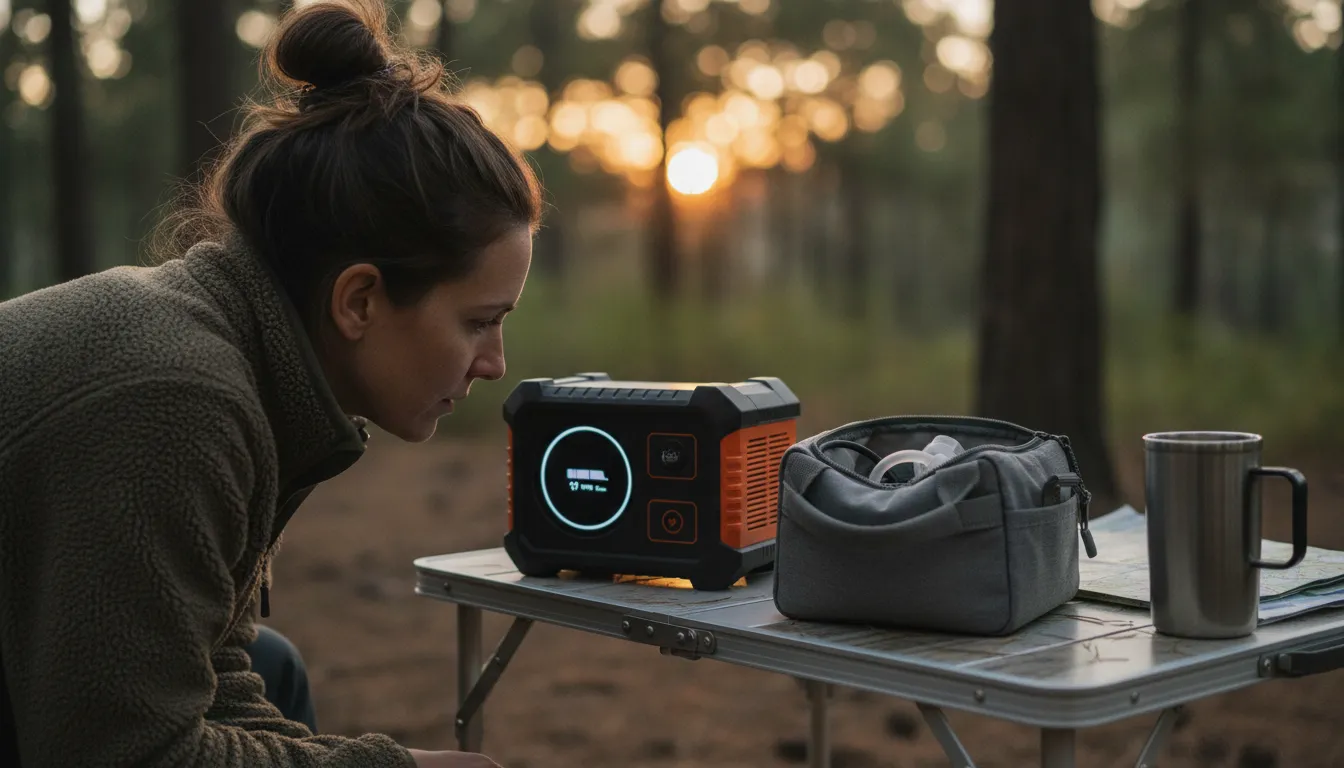
CPAP Battery vs Portable Power Station for Camping.
The best backup setup depends on what you need to power at camp. A dedicated CPAP battery is designed around one machine and a focused overnight use case. A portable power station is a broader campsite resource that can support a CPAP alongside phones, lights, cameras, and other essential devices. External batteries are especially useful when camping or traveling without reliable outlets, and they can also provide emergency backup during an outage. Compare backup power for overnight trips before choosing a format.
| Consideration | Dedicated CPAP battery | Portable power station |
|---|---|---|
| Capacity | Usually sized for the specific CPAP and the planned overnight runtime. Confirm watt-hour requirements for your machine rather than relying on a generic capacity label. | Typically offers a larger capacity reserve for overnight use plus other campsite needs. Actual runtime depends on the CPAP draw and any accessories in use. |
| Ports | Often prioritizes the compatible DC connection, with some models also offering USB output. Check connector and voltage compatibility before travel. | May combine AC outlets with DC and USB ports, making it easier to run different devices from one unit. AC operation can involve conversion losses. |
| Weight and packing | Generally the more compact choice when your priority is powering the CPAP and minimizing pack weight. | More substantial, but the added size can replace several separate chargers and batteries at an established campsite. |
| Recharging | Commonly recharges from a wall outlet or vehicle adapter. Solar compatibility varies by model. | Many models support wall and vehicle charging, with some supporting compatible solar input. Verify the manufacturer's charging requirements. |
| Price | Pricing varies by CPAP compatibility, capacity, and included cables. A lower purchase price does not help if the battery cannot cover your actual setup. | Pricing rises with capacity, port selection, and charging features. You are also paying for power that can serve devices beyond the CPAP. |
| Multiple devices | Best for a focused CPAP backup plan, with limited usefulness for a full campsite load. | Better suited to shared camp power because it can charge a CPAP and other devices, subject to total output and capacity limits. |
Choose based on the rest of your campsite
A dedicated battery makes sense for a lightweight trip where the CPAP is the primary power requirement. It can also be a practical backup kept with the machine and its required cables. A power station is more useful when you are car camping, staying several nights, or coordinating power for multiple people. Its AC, DC, and USB options can simplify camp organization, but they do not eliminate the need to verify each device's requirements.
Portable CPAP machines such as the ResMed AirMini are designed for travel and can be well suited to camping. But portability does not guarantee compatibility with every battery or power station. Check the CPAP manufacturer's specifications, calculate the expected watt-hour demand, and account for accessories before buying. Heated humidifiers and tubes can materially increase consumption. When the equipment allows it, a compatible DC setup may use stored power more efficiently than an AC inverter. For broader campsite planning, browse KEUTEK's portable power station and portable power collection.
Sources: Sleep Foundation; Academia.edu; American Sleep Apnea Association. Always verify your device's wattage, connector, voltage, and manufacturer guidance before use.
How to Recharge Your CPAP Power Bank While Camping.
A reliable recharge plan gives your CPAP power bank for camping more than one way to recover during a multi-night trip. Before leaving, fully charge the battery at home, then identify how you will replace that energy at camp. Your best option may change with the weather, driving schedule, and the battery's accepted input.
Use solar charging for gradual daytime top-ups
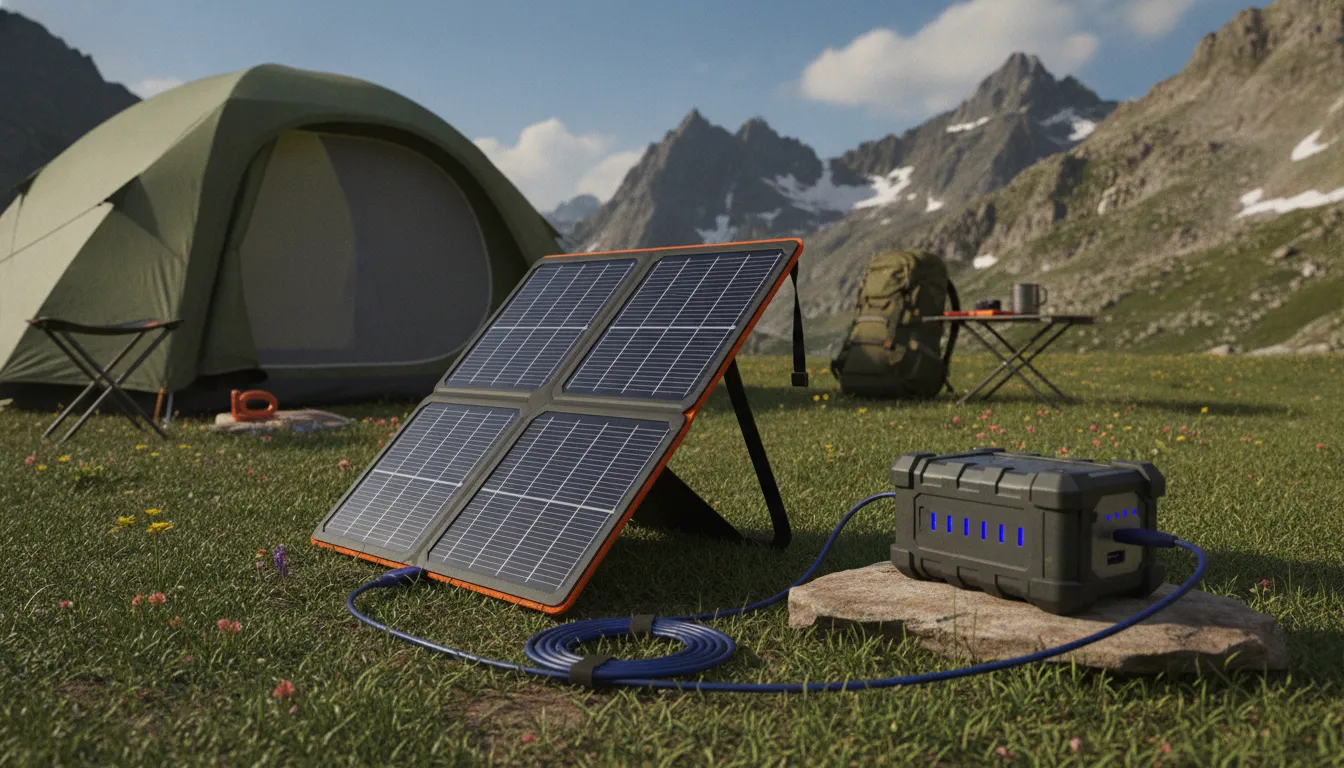
A portable solar panel can replenish a power bank while you are at camp, especially when the battery is positioned in direct, unobstructed sunlight. Solar is best treated as a daytime top-up rather than a guaranteed overnight charging solution. Cloud cover, shade, panel angle, temperature, and the power bank's input limits all affect the result.
For an overnight top-up strategy, choose a panel rated at least 20 watts. And consider a 40-watt panel when the battery accepts that input and your pack space allows it. A larger rated panel does not guarantee faster charging if the power bank limits incoming power, so confirm the manufacturer's input specifications before buying. KEUTEK's guide to the solar power bank for camping offers additional planning guidance.
Recharge from the vehicle while driving
If you are moving between campsites, use the vehicle's charging system to replenish the battery during the drive. This approach is predictable in clear weather and can complement solar charging on short winter days. Use a compatible car adapter and follow the power bank's input requirements. Do not leave a charging battery exposed to excessive heat inside a parked vehicle, and never assume that an adapter is compatible simply because its connector fits.
Start with a full charge at home
Home charging should be the foundation of the plan. Charge the power bank completely before departure, inspect cables and connectors, and confirm that the battery indicator behaves normally. Then estimate how much reserve you need for the trip rather than depending on a single recharge method. Check the CPAP machine's wattage requirements and the battery's usable capacity, particularly if you plan to use a humidifier or heated tubing.
When connecting the CPAP at camp, use a compatible DC-to-DC adapter whenever the machine and battery support one. A DC converter avoids the extra conversion step of changing battery power to AC and then converting it back for the device. The American Sleep Apnea Association notes that a DC converter can significantly improve battery life compared with an AC power inverter: source guidance on camping with a CPAP machine. Confirm the required voltage, connector, polarity, and wattage before use. Stable power matters more than improvising with an unverified adapter.
Essential Safety Tips for CPAP Camping.
A reliable CPAP power bank for camping is only useful when it is matched to your equipment and handled correctly. Before leaving home, read your CPAP manual and contact the manufacturer to confirm the machine's voltage, amperage, connector, polarity, and approved power options. Do not assume that a generic battery, adapter, or cable is safe simply because the plug fits.
Confirm compatibility before your trip
Verify your specific CPAP model's power requirements with the manufacturer before purchasing or connecting any third-party battery. Ask whether the manufacturer permits the planned battery and adapter combination, and confirm the required output. Never exceed the battery's rated output, and do not use a cable or converter that was not designed for the device's electrical requirements. If the manufacturer cannot confirm compatibility, choose an approved solution instead of experimenting at the campsite.
Protect the battery from moisture and heat
Keep the battery dry inside the tent, away from rain, condensation, wet gear, and any spilled water. At the same time, do not bury it under sleeping bags or clothing. Place it on a stable, uncluttered surface where air can circulate and the unit can dissipate heat. Follow the battery maker's instructions for operating and charging temperatures. Inspect the housing, cable, and connector before use, and stop using the setup if you notice swelling, cracking, unusual heat, odor, or damage.
Plan for air travel and unexpected problems
If you are flying to your campsite, check the battery's FAA approval and the airline's current portable-battery rules before packing. Approval and transport requirements can vary by battery type and capacity, so keep the relevant product documentation available. Sleep Foundation notes that users should verify FAA approval before taking a CPAP battery on a flight because portable-battery regulations can be strict: review its CPAP battery guidance.
Finally, pack a backup charging cable that is confirmed compatible with your CPAP setup, plus any required adapter. A spare cable cannot replace a properly sized power source, but it can prevent a damaged or misplaced cable from ending the trip early. Test the complete setup at home for a full night, and bring a backup sleep and power plan if the battery does not perform as expected.
Build your camping backup plan with KEUTEK portable power.
Frequently Asked Questions.
How do I choose the right battery capacity for a CPAP camping trip?
Start with your CPAP manufacturer's stated power draw, then compare it with the battery's usable capacity in watt-hours or amp-hours. Plan for a full night's runtime, not just the battery's headline capacity. Heated humidifiers and heated tubing can substantially increase consumption, so include those accessories in your estimate or confirm whether you can safely leave them off. The Sleep Foundation recommends choosing a battery compatible with your specific machine and long-lasting enough for your planned use. Review its CPAP battery guidance before buying.
Will a portable power station run my CPAP all night?
It may, but runtime depends on the CPAP model, pressure settings, accessories, battery capacity, and conversion losses. Do not assume that any portable power station will support your machine. Check the CPAP power requirements and the station's continuous output, then allow a margin for an entire night and any additional devices you need to charge. KEUTEK portable power products can support a broader backup-power plan, but product compatibility must be confirmed against your equipment before a trip.
Should I turn off the CPAP humidifier while camping?
If you are camping without an outlet. Turning off the humidifier can help conserve battery power because humidifiers and heated tubing consume significantly more energy than the CPAP machine itself, according to ResMed. Make that decision based on your device instructions and personal care needs. Test your planned settings at home before relying on them overnight in the field.
Is a DC adapter better than an AC inverter for off-grid CPAP use?
When a compatible adapter is available, DC power can be more efficient because it avoids converting battery power to AC and then back to the device's required voltage. The American Sleep Apnea Association notes that a DC converter can improve battery life compared with an AC power inverter. Use only an adapter approved for your specific CPAP model, and verify the voltage, connector, and polarity before connecting it.
Ready to Plan Your Camping Power Setup?
A thoughtful backup-power plan can make overnight trips easier to manage, especially when you need to account for your CPAP device and other essential electronics. Explore KEUTEK portable power solutions for your next camping trip, then confirm your equipment's wattage, connection requirements, and expected runtime before choosing a setup. Get started by comparing durable off-grid charging options for your travel needs.


Leave a comment