

Best Power Bank for International Travel: What to Pack

Finding the best power bank for international travel is not about choosing the largest number on the package. The right model must fit airline limits, show a clear watt-hour rating, charge your actual device mix at useful speed, and survive a full itinerary without creating cable or plug confusion. This guide helps you build a dependable travel charging kit before you leave home.
Shop KEUTEK portable power for a travel-ready backup charging solution.
What makes the best power bank for international travel?
Short answer: The best power bank for international travel is clearly labeled, under the capacity limit used by your airline, carry-on compatible, fast enough for your devices, and small enough to keep accessible in the cabin. It should also work with the USB cables, wall charger, and plug adapter you already plan to carry.
International travel creates more charging variables than a daily commute. You may cross time zones, spend hours in transit, work from a hotel, use navigation all day, or move between countries with different wall outlets. A good power bank is the buffer between those situations and a dead phone.
Start with the device list, not the product label. Write down the phone, tablet, headphones, camera, handheld game system, or laptop you will actually bring. Then choose capacity and output around that list. A compact phone-only kit has different needs from a multi-device work kit, even if both travelers describe themselves as needing a travel power bank.
For international trips, prioritize five characteristics:
- A watt-hour rating printed on the unit or manufacturer documentation.
- A capacity that stays within your airline and destination requirements.
- USB-C Power Delivery output matched to your phone, tablet, or laptop.
- Ports and cables that work across your devices without improvised adapters.
- A durable, protected design that can stay in your carry-on and remain easy to inspect.
Which capacity fits your itinerary?
Short answer: Choose capacity by trip length, outlet access, device count, and airline limits. A 10,000mAh bank is easier to carry for a phone-focused day. A 20,000mAh class bank suits longer travel and more than one device. A bank near 100Wh maximizes stored energy while remaining in the common carry-on range, subject to airline rules.
| Capacity class | Best fit | Tradeoff to expect |
|---|---|---|
| 10,000mAh class | It suits a traveler who mainly needs phone backup during airport transfers and sightseeing. | It offers less reserve for tablets, laptops, or several days away from an outlet. |
| 20,000mAh class | It suits longer flights, multi-device travel, and travelers who want a practical reserve without carrying a station. | It adds weight and bulk, so check the labeled Wh rating and your airline policy. |
| Near 100Wh | It suits a traveler balancing maximum carry-on energy with a phone, tablet, or compatible laptop kit. | It is heavier and closer to aviation limits, so the label and current airline rules matter more. |
Milliamp-hours alone do not tell the whole story. Watt-hours account for voltage and are the figure aviation authorities use for battery limits. If the Wh rating is not printed, the basic conversion is Wh = volts x amp-hours. For milliamp-hours, divide by 1,000 to get amp-hours, then multiply by the nominal voltage. Do not guess from a marketing name when an airline agent needs to verify the battery.
Also remember that rated capacity is not the same as energy delivered to a device. Voltage conversion, heat, cable quality, and charging overhead reduce the usable amount. Treat a capacity estimate as planning guidance rather than a promise of a fixed number of phone charges.
How do airline limits affect your choice?
Short answer: For the safest general starting point, choose a power bank with a clearly marked rating of 100Wh or less and pack it in your carry-on. The FAA says 101 to 160Wh spare lithium-ion batteries require airline approval and batteries over 160Wh are not permitted for ordinary passenger travel. Airlines and countries can apply stricter rules.
The rules below are a selection checkpoint, not a universal travel clearance. Before departure, check every operating airline, including a codeshare carrier, and confirm the destination country or airport guidance if it differs. Rules can change after you buy the product.
- Carry-on only: The TSA says lithium-ion power banks belong in carry-on bags and are not allowed in checked bags. If your carry-on is taken at the gate, remove the power bank and keep it with you in the cabin.
- 0 to 100Wh: The FAA lists this range as allowed for spare lithium-ion batteries for personal use, subject to packing and airline requirements.
- 101 to 160Wh: The FAA says airline approval is required, with a limit of two larger spare lithium-ion batteries. Do not assume a large power bank will be accepted just because it fits in your bag.
- Over 160Wh: The FAA lists this range as forbidden for ordinary passenger aircraft travel.
- Current operator rules: IATA guidance for the 2026 regulatory update notes additional limits on power banks, including carry-on storage, protection against short circuits, and restrictions on recharging or using them during a flight. The operating airline remains the final source for your itinerary.
Read the official FAA passenger battery guidance and the TSA power bank guidance before packing. For international trips, also review IATA's passenger lithium battery guidance. A power bank that is damaged, swollen, recalled, or unable to show its rating should not be packed for a flight.
What charging speed and ports should you choose?
Short answer: Match output watts to the devices you carry, then confirm the bank can deliver that output through the port you will use. USB-C Power Delivery is the most useful baseline for current phones, tablets, and many laptops. Multiple ports help a family or work kit, but total output may be shared across ports.
Capacity determines how long the reserve can last. Output determines how quickly a connected device can recover. A high-capacity bank with weak output can still leave a laptop charging slowly, while a fast bank with too little capacity may run out before the end of a long travel day.
Use your device specifications as the starting point:
- A phone-focused kit benefits from a USB-C PD output appropriate for the phone's own charging limit.
- A tablet or handheld gaming device may need more output than a phone, especially while in use.
- A USB-C laptop can require substantially more power, and not every power bank supports laptop charging.
- Headphones, watches, cameras, and other small electronics may charge from lower-output ports, but confirm their connector and cable needs.
Check both output and input. A bank that charges devices quickly but takes most of the night to refill can be inconvenient between destinations. If you are moving through hotels and airports, fast self-recharging can matter as much as fast device charging. Use a wall charger and cable that meet the bank's input requirements, rather than assuming any USB-C accessory will deliver the same result.
When charging several devices, look for the bank's simultaneous-use and total-output specifications. The maximum number printed on a package may describe one port or a combined total under a specific setup. Select a product whose published limits match how many devices you will power at once.
See the KEUTEK 99Wh portable solar power bank for a rugged, travel-focused option, then confirm the current airline policy for your route.
Related products


In today's interconnected world, reliable and efficient power is not just a convenience—it is a necessity.
View product
How do plug and cable compatibility fit together?
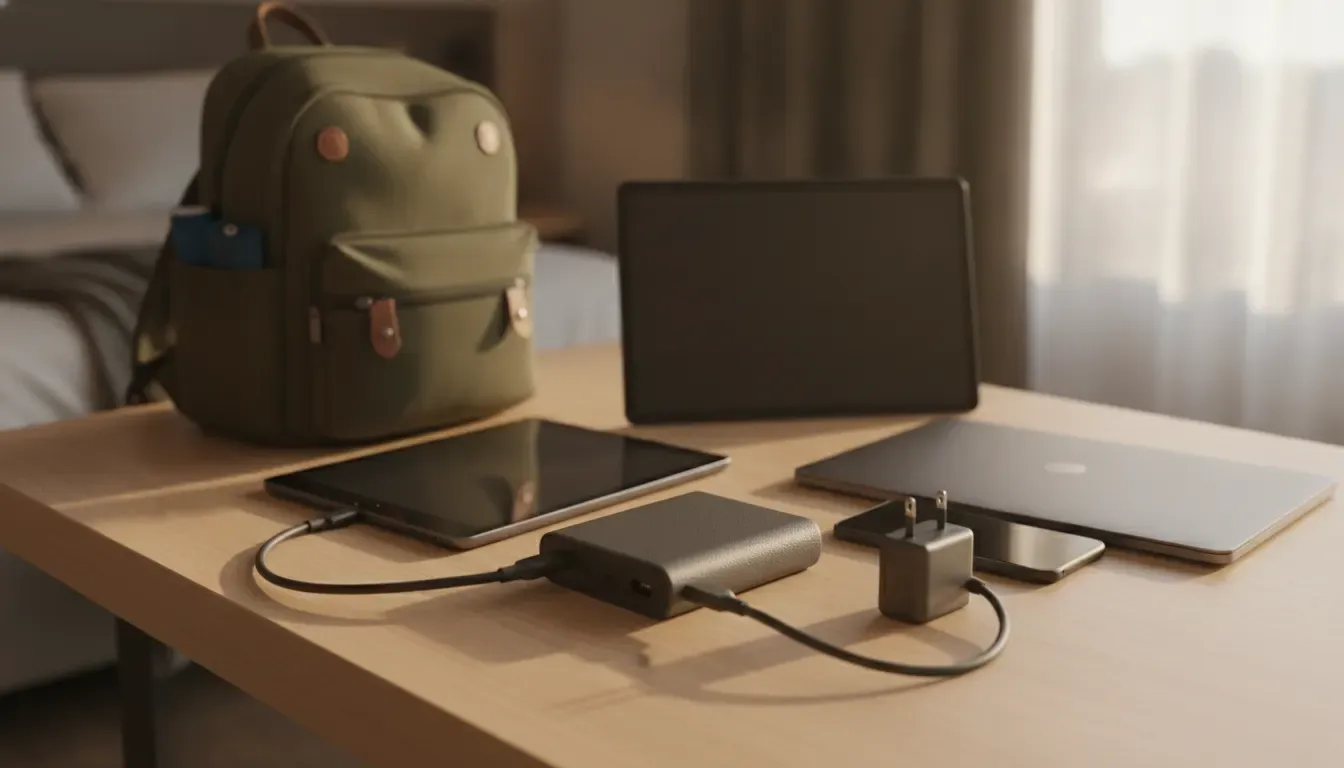
Short answer: A power bank solves portable battery backup, but it does not replace the wall charger or plug adapter you need at your destination. Build the system as three separate parts: the power bank, the charging cables, and a destination-compatible wall charging setup.
Most power banks output through USB, so the wall outlet shape at your hotel does not change how the bank charges your phone. The outlet does affect how you refill the bank and your devices when you have access to mains power.
Choose the cable for the device, not the destination
USB-C to USB-C is a practical choice for many current phones, tablets, and laptops, but older accessories may use USB-A, Lightning, or another connector. Pack a cable for every device you intend to charge and check that the cable supports the power level your device and bank require. A cable can become the bottleneck even when the power bank and phone both support fast charging.
For a durable, universal charging setup, review the KEUTEK ProSeries Max fast-charging cable and confirm that its connector configuration fits your devices before packing. Do not rely on an unfamiliar cable purchased at the airport.
Choose the plug adapter for the country
A plug adapter changes the shape of the connection. It does not automatically convert voltage. Check that your wall charger's input range supports the destination's electrical system, and use a voltage converter only when the charger or appliance requires one. This distinction matters because an adapter that fits the wall does not guarantee that the connected charger is electrically compatible.
If you are visiting several countries, a quality universal adapter can reduce clutter, but it should not block the adjacent outlet or become the only way to charge every device. Keep the power bank and one essential cable in your personal item so you still have backup power if your checked luggage is delayed.
Can one power bank run multiple devices?
Short answer: One power bank can support several devices when its ports, total output, capacity, and cables match the load. The practical limit is not the number of sockets alone. It is the bank's shared output and the energy required by each device while it is being used.
For a phone, earbuds, and smartwatch, a modest bank with multiple compatible ports may be enough. A phone, tablet, camera, and laptop create a larger load, especially if you are navigating, recording video, or working while charging. In that case, compare the bank's per-port output and total simultaneous output before you leave.
Plan the order of use. A phone used for boarding passes, maps, translation, and payments deserves priority. Top it up before charging less urgent devices. If the bank supports pass-through charging, verify the manufacturer's guidance before depending on it, since some travel rules or safety recommendations may restrict charging a power bank onboard an aircraft.
Use a short travel checklist:
- List every device and connector.
- Identify the highest wattage device.
- Confirm the bank's output for that device.
- Confirm total output when more than one device is connected.
- Pack one spare cable only when it solves a real failure point.
What durability and safety features matter?
Short answer: A travel power bank should have protected ports, a readable capacity label, thermal and over-current safeguards, and construction that can handle normal movement in a carry-on. Water resistance can help outdoors, but no rating makes a damaged lithium battery safe to fly with.
Look for a design that is easy to inspect. A clear label with voltage and Wh information can prevent delays when security or airline staff need to verify the battery. Keep the bank in a small pouch so its ports do not contact keys, coins, or other metal objects.
Durability is practical risk management. A reinforced enclosure and protected connectors reduce the chance that normal packing damages the bank. They do not justify dropping it, crushing it under luggage, exposing it to heat, or packing it after it has swollen. If the bank becomes unusually hot, smells abnormal, expands, smokes, or shows visible damage, disconnect it and follow the airline or manufacturer safety instructions.
For a premium travel setup, also consider support and warranty terms. A long-term warranty and responsive customer service cannot change airline limits, but they can make the ownership decision more dependable when a travel accessory is part of your everyday kit.
How should you pack a power bank for an international trip?
Short answer: Charge and test the bank before leaving, keep it in your personal item, protect its terminals, and make the Wh rating easy to find. Pack the cables and plug adapter beside it, but keep the battery accessible rather than buried in a checked suitcase or an overstuffed overhead bag.
- Check the label: Confirm the Wh rating is visible and matches the product documentation.
- Check the route: Review each airline's battery rules, including connections and codeshare flights.
- Inspect the bank: Do not travel with a swollen, damaged, recalled, or unusually hot battery.
- Charge before departure: Test the bank with your actual cable and at least one device.
- Protect the ports: Use a pouch or case to prevent accidental contact with metal objects.
- Keep it with you: Put it in a personal item or accessible carry-on, never checked baggage.
- Pack the wall setup: Bring the destination plug adapter and a compatible wall charger.
- Check onboard use: Follow the operating airline's current instructions about storing, using, or recharging the power bank in flight.
Do not wait until the security line to discover that the capacity label is missing or the only cable you packed cannot connect to your phone. A five-minute test at home is more useful than a last-minute purchase in an unfamiliar terminal.
Which power bank is best for international travel?
Short answer: For most international travelers, the best power bank is a clearly labeled model at or below 100Wh with USB-C PD output, enough capacity for the actual itinerary, multiple compatible cables, and a durable carry-on-friendly design. The final choice depends on your devices, airline, destination, and how often you will reach a wall outlet.
Choose the lightest capacity that comfortably covers your plan. Select 10,000mAh class power for phone-first day trips, 20,000mAh class power for longer routes and multiple devices, or a near-100Wh model when you need more reserve and can manage the extra weight. Then verify the output, cable, and airline details before purchase.
KEUTEK's portable power range is built around fast charging, travel-ready durability, and cross-device use. Review the product specifications, pair the bank with the right cable and wall charger, and treat airline guidance as a required final check rather than an assumption.
Build your international travel charging kit with KEUTEK portable power and verify your airline's current battery policy before departure.
Frequently asked questions
Can I bring a 20,000mAh power bank on an international flight?
A 20,000mAh label does not by itself determine approval. Check the marked watt-hour rating, keep the bank in carry-on baggage, and confirm every operating airline's current rules. A power bank at or below 100Wh is the common starting point, but airline or destination requirements can be stricter.
What is the best power bank size for a long flight?
Many travelers choose a 10,000mAh or 20,000mAh class bank depending on device count and outlet access. A larger near-100Wh bank can provide more reserve, but it also adds weight. Choose the smallest capacity that covers your phone, tablet, or laptop plan and stays within the route's rules.
Can a power bank go in checked luggage?
No. The TSA says portable chargers and lithium-ion power banks must be packed in carry-on bags, not checked luggage. If your carry-on is gate-checked, remove the power bank and keep it with you in the cabin.
How do I calculate a power bank's watt-hours?
Multiply volts by amp-hours. If the label shows milliamp-hours, divide that number by 1,000 first. For example, a 5Ah battery at a nominal 3.7V is 18.5Wh. Use the manufacturer's marked Wh rating when available, because aviation staff may need to verify the battery directly.
Do I need a plug adapter for a power bank?
You do not need a plug adapter to use the power bank as a battery, but you may need one to recharge the bank or your devices from a destination wall outlet. A plug adapter changes the plug shape, not the voltage. Confirm that your wall charger supports the destination's electrical system.
Can I use or recharge a power bank on a plane?
Rules vary by airline and may change. Current international guidance includes restrictions on recharging power banks onboard and recommendations or limits related to using them during flight. Check the operating airline's instructions before boarding and follow crew directions.


Leave a comment