

Best Portable Charger for Camping: Complete Buying Guide

The best portable charger for camping keeps essential devices available without forcing you to carry unnecessary battery weight. Phones now handle navigation, weather alerts, photos, and emergency communication, so capacity planning deserves the same care as food and water planning. Before choosing a power bank, identify every device you will carry, estimate how often each one needs charging, and account for your route, weather, and access to power. KEUTEK offers portable power options designed for campers who value dependable, travel-ready charging.
Explore KEUTEK fast-charging portable power for your next camping trip.
Choose a camping charger by matching usable capacity to trip length, then confirm that its weight, ports, and weather resistance fit the route. A compact bank may be ideal for one night, while a longer off-grid stay can justify higher capacity or solar support. Build in a reserve for cold conditions, unexpected delays, and energy lost during charging.
How to choose the best portable charger for camping
A reliable choice starts with the trip, not the largest capacity number on a product page. Backpackers must manage every gram, while car campers can carry a heavier bank that supports several devices. A solo hiker using a phone sparingly has different requirements from a family charging phones, tablets, cameras, and lights at a base camp.
Evaluate capacity, usable output, weight, port compatibility, and construction as one system. A high-capacity bank offers little value if it is too heavy to bring, and fast output is wasted when the cable or device cannot support it. Weather resistance also matters, but even a rugged charger should be stored carefully and protected from extreme temperatures.
Start with a device and usage inventory
List each phone, tablet, camera, headlamp, and other rechargeable tool. Record its battery capacity when available, then estimate how many full or partial recharges it will require. Navigation, photography, music, and weak cellular signals can increase phone use, so plan around realistic trail behavior rather than ideal battery life.
Add a reserve instead of selecting a bank that meets the estimate exactly. Energy is lost as heat during charging, and the full rated capacity does not reach the connected device. The article's planning benchmark is that a charger often delivers about two-thirds of its listed energy. A reserve also protects against an extra night, colder weather, or a companion who needs help.
Distinguish backpacking from base-camp needs
For backpacking, the best bank is usually the smallest model that covers the calculated demand plus a sensible reserve. Compact units under 200 grams suit short trips and reduce pack burden. For car camping or a fixed base camp, additional capacity may be more valuable than minimal weight because the charger does not need to travel far each day.
Long stays, groups, and laptop use can justify a unit holding 25,000mAh or more. Solar support can also make sense at a sunny base camp, but it should be treated as a replenishment method rather than an excuse to skip capacity planning. Review KEUTEK's high-capacity portable solar power bank when off-grid recharge options are part of the plan.
Calculate the battery capacity your trip requires
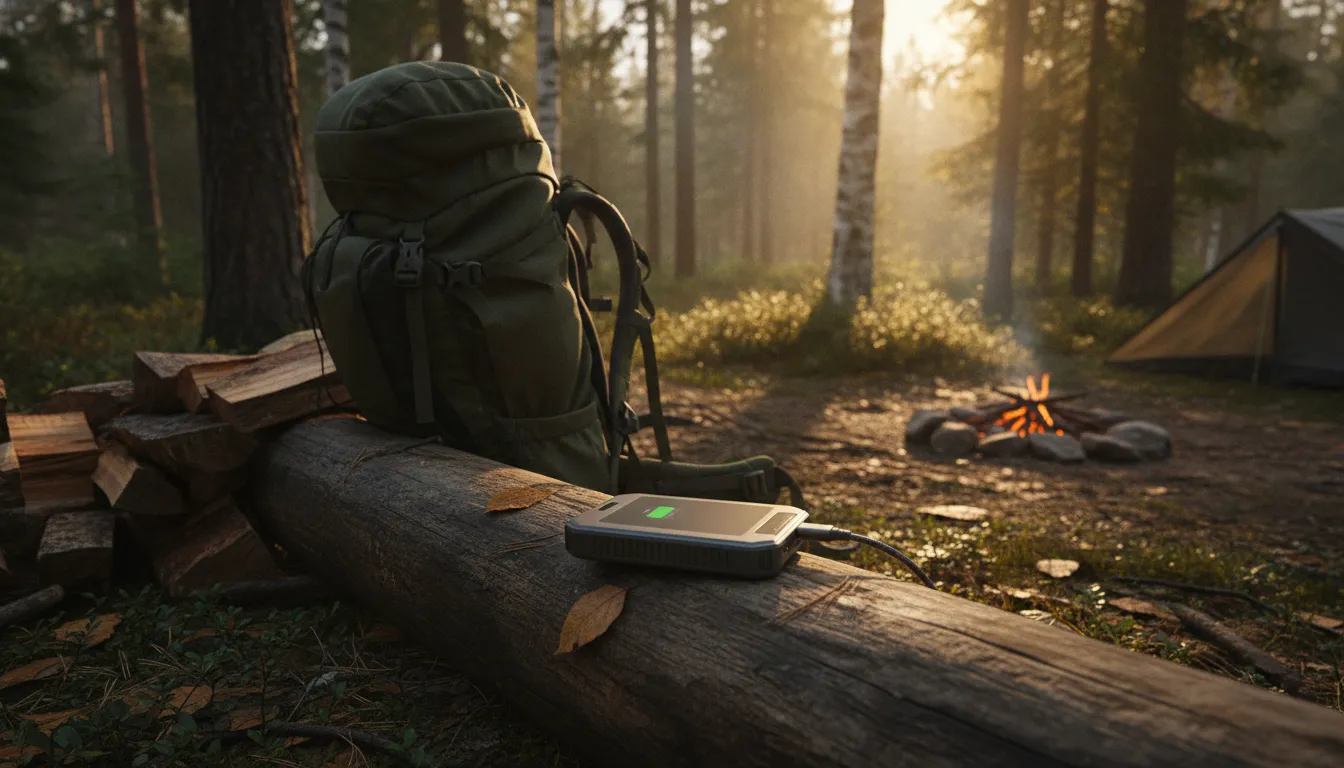
Power-bank capacity is listed in milliamp hours, or mAh. Higher capacity generally means more potential charges, but it also tends to mean more size and weight. The practical goal is not to maximize mAh. It is to carry enough usable energy for the trip while preserving an appropriate safety margin.
Capacity for one night or a weekend
A 6,000mAh charger can provide about 1.5 full phone charges, making it a useful benchmark for light use on a short stay. A unit around 10,000mAh gives a one-night camper more flexibility for navigation, photos, or an unexpected drain. Start fully charged and reduce waste by downloading maps before leaving service.
For a weekend, 20,000mAh can provide a more comfortable reserve, especially when a phone is used throughout the day. A 19,200mAh unit can charge a phone about five times. Actual results vary with the phone, cable, temperature, and conversion loss, so use those figures for planning rather than as a guarantee.
Capacity for longer and group trips
Trips of three days or more require a more detailed energy budget. Add the expected demand for each device and each day, then include a reserve. Tablets, cameras, and laptops increase the requirement quickly. Sharing one bank among several campers also calls for clear rules about which devices are essential and when they should be charged.
For a week away from outlets, a larger bank or a solar-supported setup may be appropriate. Units holding 25,000mAh or more can suit long stays, groups, or laptops, but only when their output and ports match those devices. Campers should still arrive with every device and bank at full charge rather than relying on solar input from the first day.
Account for cold and conversion loss
Cold conditions slow the chemical reactions inside a battery, reducing available performance. Keep the power bank insulated in a pack or close to your body during cold travel. At night, storing it in a protected location near your sleeping bag can help. Avoid placing it directly on cold, damp ground.
Charging also loses energy as heat. For example, a 10,000mAh bank will not deliver its entire rated capacity to a phone. This is why dividing listed capacity by the phone's battery size can overstate the number of charges. Use conservative estimates and preserve reserve power for navigation and communication.
Balance capacity against pack weight
Capacity and weight must be evaluated together. A bank that provides abundant power but stays at home because it is too heavy has no field value. Short-distance car campers can prioritize capacity, while long-distance hikers should calculate the minimum dependable setup and remove unnecessary devices before adding more battery.
Light banks under 200 grams can serve day trips or a single night. Larger, rugged units may weigh more than 500 grams. A 19,200mAh unit often weighs about 577 grams and can charge a phone roughly five times. Those reference points help compare trade-offs, but the correct choice depends on distance, terrain, trip length, and device use.
| Charger Type | Best Use Case | Approx. Weight | Phone Charges |
|---|---|---|---|
| Light | Day trips or one night | Under 200g | 1.5 charges |
| Mid-size | 2-3 day camping trips | About 577g | 5 charges |
| High capacity | Group trips or laptops | Over 700g | 8+ charges |
Do a final pack test before departure. Carry the loaded pack on a representative walk, then decide whether added capacity is worth its weight. If not, reduce nonessential device use or choose a smaller bank with a disciplined charging plan.
Compare KEUTEK portable power options and match capacity to your route.
Choose weather resistance for outdoor conditions
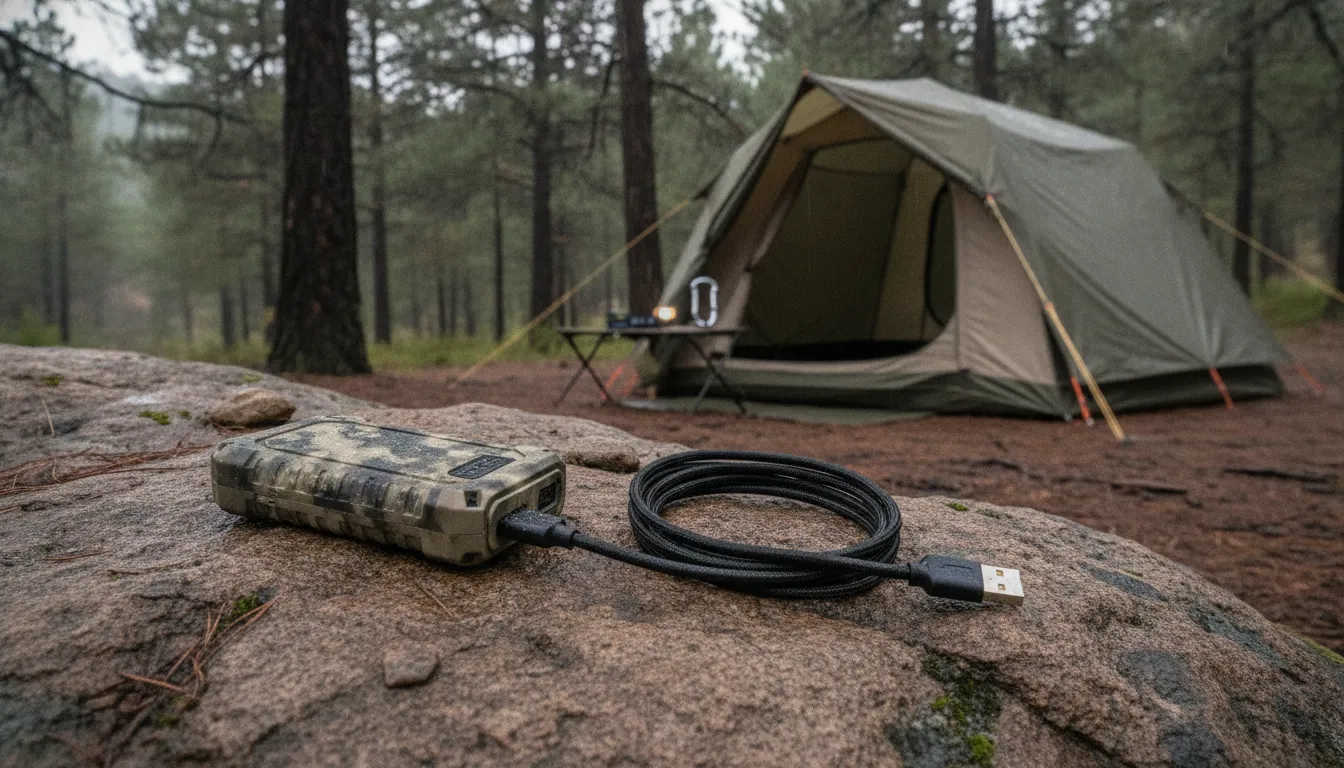
Camping exposes electronics to rain, dust, mud, and drops that rarely affect a charger used at home. A rugged case and documented Ingress Protection rating help reduce that risk. KEUTEK's guide to rugged portable chargers for outdoor use explains the role construction plays beyond capacity alone.
Understand IP ratings
An IP67 rating indicates strong resistance to dust and water. The first digit shows dust protection, while the second addresses water protection. IP67 means the case is dust-tight and can withstand immersion in one meter of water for thirty minutes. That level is useful around rain, spills, dirt, and creek crossings.
A lower rating such as IPX4 protects against light rain but does not provide the same dust protection or immersion resistance. Select the rating for the conditions you expect, then continue treating the bank as important electronics. A rating is a safeguard, not permission to leave the charger exposed.
Protect ports and control temperature
Port covers help keep sand, mud, and moisture away from USB connections. Close them whenever the bank is not charging. Store the unit in a dry bag during wet travel, keep it off damp ground, and inspect ports before inserting a cable. If a cable or port is wet, dry it before connecting anything.
Extreme heat and cold can reduce battery performance. Keep the bank in shade during hot weather and insulated during cold weather. Condensation can form when a cold charger enters a warm tent, so leave it sealed while it warms gradually. These basic controls protect both the battery and connected devices.
- Inspect the case, seams, ports, and covers before leaving.
- Use a dry bag when rain or water crossings are likely.
- Keep the charger shaded and away from direct heat.
- Let wet or cold equipment dry and normalize before use.
Check charging speed, ports, and cable compatibility
A power bank must connect correctly to every essential device. Modern units often include USB-C and USB-A ports, and multiple ports can support two devices at once. Confirm the connector type and power requirement for each phone, camera, tablet, or laptop before buying or packing.
Some USB-C ports can provide speeds up to 18W for compatible phones. Fast output reduces the time a device remains tethered at camp, but the full charging chain matters. The bank, cable, and device must all support the intended rate. A mismatched cable can limit performance even when the bank offers faster output.
Use a dependable cable such as a ProSeries Max fast-charging cable when its connectors suit your devices. Test every bank, port, and cable together at home. This reveals damaged connectors, incompatible combinations, and unexpected charging behavior before those problems become difficult to solve outdoors.
Consider input speed as well as output
Output controls how quickly the bank charges a device. Input controls how quickly the bank itself refills. Input speed matters when an itinerary includes only a brief stop near an outlet. Recharge time can also affect how useful a solar-supported bank is during a longer base-camp stay.
Do not assume a bank is ready because it was charged weeks ago. Top it off shortly before departure and confirm that it reaches full capacity. The CDC recommends charging phones and other electronic devices before severe weather, a sound practice for camping preparation as well.
Prepare and test your camping power system
Field reliability depends as much on preparation as product selection. A charger can meet every specification and still fail the trip if it leaves home partly charged, uses the wrong cable, or sits unprotected in a wet pack. Run a complete test several days before departure, leaving time to correct any issue.
- List every rechargeable device and classify it as essential or optional.
- Estimate daily use and the number of required charges.
- Add a reserve for conversion loss, weather, and delays.
- Confirm that each cable and port matches its device.
- Inspect the bank for cracks, loose parts, damage, or unusual smells.
- Charge the bank and every device to full before packing.
During the test, use the same cables and charging sequence planned for camp. Confirm that simultaneous charging behaves as expected if more than one port will be used. Check that the bank fits in its intended dry bag or protective pouch and remains accessible without unpacking everything.
Manage energy deliberately at camp
Preserve battery life by downloading maps, permits, and essential documents for offline access. Lower screen brightness, use airplane mode when appropriate, and close unneeded applications. Keep a dedicated reserve for navigation and emergency communication instead of spending the entire supply on entertainment or routine photography.
Charge devices in a dry, stable location where connectors will not be strained. Disconnect equipment after it is charged, close port covers, and store the bank away from heat and moisture. If conditions worsen, prioritize essential devices and avoid waiting until every battery is nearly empty.
Common mistakes when selecting camping power
The first mistake is buying by capacity alone. Capacity does not address weight, weather resistance, connector compatibility, or output. The second is assuming listed mAh converts directly into device charges. Conversion loss and cold conditions make conservative planning more dependable.
Another mistake is relying on solar support without starting at full charge. Weather, shade, positioning, and time can affect replenishment. Solar can extend an off-grid setup, but the bank should still cover core requirements and a reserve. Test the full setup before depending on it.
Finally, do not pack untested cables or leave port protection to chance. One damaged connector can make otherwise adequate capacity inaccessible. A short home test, a dry storage plan, and disciplined use at camp provide more practical reliability than simply choosing the largest available battery.
Final checklist for dependable camp charging
The best portable charger for camping is the one that fits the route, supports every essential device, and remains manageable in the pack. Calculate realistic demand, account for energy loss, select the appropriate capacity and weight, then verify ports and weather protection. Preparation turns those specifications into a dependable field system.
KEUTEK helps campers build practical charging kits for short hikes, family base camps, and longer off-grid trips. Choose the bank and cables around your actual devices, test them as a complete system, and leave home with everything fully charged.
Review KEUTEK portable solar power for longer off-grid stays.
Frequently asked questions
What mAh power bank is best for camping?
For a short trip, a 10,000mAh unit is often enough to keep a phone ready. For three days or more, consider 20,000mAh. A 19,200mAh battery can charge a phone about five times, but cold conditions, cables, and conversion loss affect real results. Build in a reserve rather than planning around the maximum estimate.
Are rugged portable chargers worth it for camping?
Yes, especially where rain, dust, spills, or drops are likely. An IP67 rating indicates resistance to dust and water, which is useful outdoors. Rugged construction does not eliminate the need for careful handling. Keep ports covered, use dry storage, and protect the bank from extreme heat and cold.
How do I choose a portable charger for backpacking vs car camping?
For backpacking, prioritize a lightweight charger that covers essential demand plus a reserve; units under 200 grams can suit short trips. For car camping, a larger and heavier unit may be practical because pack weight matters less. That extra capacity can support multiple devices or a laptop.
Is a 20000mAh power bank overkill for camping?
Not necessarily. A 20,000mAh power bank is useful for trips longer than two days, charging tablets, sharing power, or maintaining a larger reserve. It may be more capacity than a light overnight trip requires. Compare its weight with your expected demand before deciding.


Leave a comment